


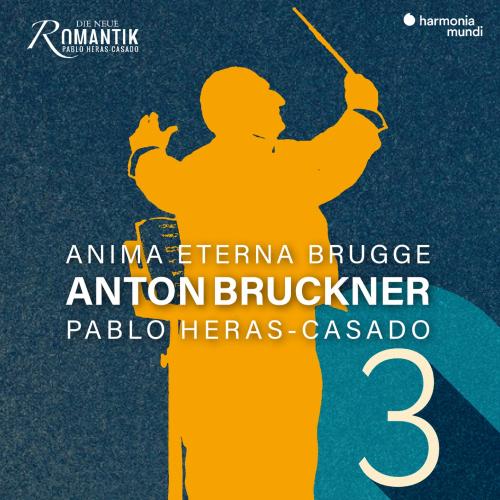
Bruckner: Symphony No. 3, "Wagner Symphony" Anima Eterna & Pablo Heras-Casado
Album Info
Album Veröffentlichung:
2026
HRA-Veröffentlichung:
21.08.2026
Label: Harmonia Mundi
Genre: Classical
Subgenre: Orchestral
Interpret: Anima Eterna & Pablo Heras-Casado
Komponist: Anton Bruckner (1824-1896)
Das Album enthält Albumcover Booklet (PDF)
- Anton Bruckner (1824 - 1896): Symphony No. 3 in D Minor, WAB 103 "Wagner Symphony" (1873 Version):
- 1 Bruckner: Symphony No. 3 in D Minor, WAB 103 "Wagner Symphony" (1873 Version): Ia. Gemäßigt, misterioso [Bars 1-122] 03:31
- 2 Bruckner: Symphony No. 3 in D Minor, WAB 103 "Wagner Symphony" (1873 Version): Ib. Gemäßigt, misterioso [Bars 123-299] 05:20
- 3 Bruckner: Symphony No. 3 in D Minor, WAB 103 "Wagner Symphony" (1873 Version): Ic. Gemäßigt, misterioso [Bars 300-459] 04:30
- 4 Bruckner: Symphony No. 3 in D Minor, WAB 103 "Wagner Symphony" (1873 Version): Id. Gemäßigt, misterioso [Bars 460-561] 03:23
- 5 Bruckner: Symphony No. 3 in D Minor, WAB 103 "Wagner Symphony" (1873 Version): Ie. Gemäßigt, misterioso [Bars 562-746] 05:34
- 6 Bruckner: Symphony No. 3 in D Minor, WAB 103 "Wagner Symphony" (1873 Version): IIa. Adagio. Feierlich [Bars 1-64] 04:00
- 7 Bruckner: Symphony No. 3 in D Minor, WAB 103 "Wagner Symphony" (1873 Version): IIb. Adagio. Feierlich [Bars 65-88] 01:24
- 8 Bruckner: Symphony No. 3 in D Minor, WAB 103 "Wagner Symphony" (1873 Version): IIc. Adagio. Feierlich [Bars 89-160] 04:32
- 9 Bruckner: Symphony No. 3 in D Minor, WAB 103 "Wagner Symphony" (1873 Version): IId. Adagio. Feierlich [Bars 161-223] 02:58
- 10 Bruckner: Symphony No. 3 in D Minor, WAB 103 "Wagner Symphony" (1873 Version): IIe. Adagio. Feierlich [Bars 224-278] 04:19
- 11 Bruckner: Symphony No. 3 in D Minor, WAB 103 "Wagner Symphony" (1873 Version): III. Scherzo. Ziemlich schnell 06:17
- 12 Bruckner: Symphony No. 3 in D Minor, WAB 103 "Wagner Symphony" (1873 Version): IVa. Finale. Allegro [Bars 1-159] 03:27
- 13 Bruckner: Symphony No. 3 in D Minor, WAB 103 "Wagner Symphony" (1873 Version): IVb. Finale. Allegro [Bars 160-309] 03:25
- 14 Bruckner: Symphony No. 3 in D Minor, WAB 103 "Wagner Symphony" (1873 Version): IVc. Finale. Allegro [Bars 310-467] 02:47
- 15 Bruckner: Symphony No. 3 in D Minor, WAB 103 "Wagner Symphony" (1873 Version): IVd. Finale. Allegro [Bars 468-599] 02:38
- 16 Bruckner: Symphony No. 3 in D Minor, WAB 103 "Wagner Symphony" (1873 Version): IVe. Finale. Allegro [Bars 600-764] 03:02
Info zu Bruckner: Symphony No. 3, "Wagner Symphony"
Nach ihrer für ihren frischen Ansatz gelobten Aufnahme der Vierten setzen Pablo Heras-Casado und Anima Eterna ihre Erkundung des Werks von Bruckner mit dessen Dritter Symphonie fort. In ihrer härteren, gewagteren Originalfassung von 1873 offenbart die „Wagner-Symphonie“ einen von Leidenschaft erfüllten Komponisten, der noch frei von jeglicher Selbstzensur ist. Diese radikale Interpretation mit historischen Instrumenten wird von einer mitreißenden, grenzenlosen Energie getragen.
Im Herbst 1872 begann Anton Bruckner mit der Arbeit an seiner Sinfonie Nr. 3 in d-Moll, die er nach ihrer Fertigstellung im folgenden Jahr zusammen mit der Sinfonie Nr. 2 in c-Moll während eines Besuchs in Bayreuth seinem verehrten Richard Wagner zur Widmung anbot; dieser entschied sich für die „Dritte“, die ihm daraufhin ebenfalls „in tiefster Ehrerbietung gewidmet“ wurde. Die einzige „Wagner-Sinfonie“ ist jedoch die „Fassung von 1873“, die noch alle Anspielungen, Reminiszenzen und Zitate aus den Werken ihres Widmungsträgers enthält, der sich somit in der sinfonischen Reflexion seines Œuvres wiedererkennen konnte, die Bruckner ihm angeblich vorwarf, ohne jedoch zu erkennen, dass es sich vielmehr um eine bewusste Aneignung spezifischer Elemente seiner Musiksprache durch seinen Bewunderer handelte.
Bruckners musikalische Hommage an den „geliebten, unsterblichen Meister“ verbindet sich mit zwei Kompositionen Wagners: der Faust-Ouvertüre in d-Moll, aus der Bruckner ein Motiv entnahm, das er im letzten Satz seines 1878/79 komponierten Streichquintetts in F-Dur verwendete, sowie die Vertonungen von fünf Gedichten von Mathilde Wesendonck, die als „Wesendonck-Lieder“ bekannt wurden; zwei davon, „Im Treibhaus“ und „Träume“, bezeichnete Wagner ausdrücklich als „Studie für ‚Tristan und Isolde‘“ – eine Oper, zu deren Uraufführung Bruckner 1865 nach München gereist war.
„Eine Tradition einfach nur fortzuführen, ohne darüber nachzudenken, tötet die Kunst und ist ein Zeichen intellektueller Trägheit. Man muss Raum für Ungewissheit lassen. Sich selbst überraschen zu können, ist ein enorm wichtiges Element der Kreativität. Unsere Interpretation von Bruckners 3. Sinfonie klingt transparenter als das, was man gewohnt ist, mit einer gewissen Leichtigkeit im Klang, aber nicht in der Botschaft.“ (Pablo Heras-Casado)
Anima Eterna Brugge
Pablo Heras-Casado, Dirigent
Pablo Heras-Casado
verfügt über ein Repertoire, das von der alten Musik in historisch informierter Interpretation über die großen Symphonien und Opern bis zu zeitgenössischen Werken reicht. Er dirigiert regelmäßig die bedeutendsten Klangkörper von Europa und den USA: Genannt seien die Berliner und die Wiener Philharmoniker, das Concertgebouworkest, die Staatskapelle Dresden, das Orchestre de Paris, das Orchestre Philharmonique de Radio France, das London Symphony Orchestra, die Philharmonia London, die Staatskapelle Berlin, die Münchner Philharmoniker, das Symphonieorchester des Bayerischen Rundfunks, das NHK Symphonieorchester sowie die Symphonieorchester von San Francisco, Chicago, Pittsburgh, Minnesota, Philadelphia, Los Angeles, Montreal usw. Eine lange Zusammenarbeit verbindet ihn mit dem Freiburger Barockorchester, mit dem er ausgedehnte Tourneen unternimmt und Aufnahmen macht, erst kürzlich den Sommernachtstraum von Mendelssohn. Im Sommer 2022 begann seine Partnerschaft mit dem Ensemble Anima Eterna Brugge, mit dem er wiederholt auf Tournee ging und auf historischen Instrumenten die Symphonien von Bruckner einspielte.
Er ist ständiger Gastdirigent der Wiener Staatsoper (u.a. die drei Opern von Monteverdi, La clemenza di Tito, Le Grand Macabre), und jüngst debütierte er in Bayreuth mit Parsifal und an der Opéra national de Paris mit Così fan tutte. Als Erster Gastdirigent des Teatro Real von Madrid dirigierte er dort den ganzen Ring und Die Meistersinger von Nürnberg. Er arbeitete auch am Teatro alla Scala, an der Staatsoper Unter den Linden und der Deutschen Oper Berlin, an der Metropolitan Opera von New York, am Festival von Aix-en-Provence und in Baden-Baden.
In seiner umfangreichen Diskografie bei harmonia mundi figurieren die Reihe "Die Neue Romantik" (Mendelssohn, Schubert, Schumann), Alben zum 250. Geburtstag von Beethoven (mit dem Freiburger Barockorchester), Werke von Manuel de Falla (mit dem Mahler Chamber Orchestra), Debussy (mit der Philharmonia London), Schumann und Bartók (mit den Münchner Philharmonikern), Le Sacre du printemps von Strawinsky und das Violinkonzert Alhambra von Péter Eötvös (mit dem Orchestre de Paris und Isabelle Faust); erwähnt seien außerdem die beiden DVD-Produktionen Der fliegende Holländer (Teatro Real) und Selva morale e spirituale von Monteverdi (Balthasar-Neumann-Chor und -Ensemble). Er machte auch Aufnahmen für die Deutsche Grammophon, für Decca und Sony Classical.
Mit Leidenschaft widmet sich Heras-Casado als Lehrer und Vermittler dem Nachwuchs. So arbeitet er mit jungen Musikern in der ganzen Welt und leitet Ensembles und Projekte für die Jugend (Karajan Akademie der Berliner Philharmoniker, Juilliard School of Music Orchestra und Juilliard415 Ensemble, RCO Young, Escuela de Música Reina Sofia, Fundación Barenboim-Said, Joven Orquesta Nacional de España, Gustav Mahler Akademie).
Er wurde vielfach ausgezeichnet, u.a. ist er ehrenamtlicher Botschafter und Träger der goldenen Verdienstmedaille des Rats von Granada, Ehrenbürger der Provinz von Granada (seiner Geburtsstadt) und Ritter des Ordre des Arts et des Lettres der französischen Republik.
Booklet für Bruckner: Symphony No. 3, "Wagner Symphony"