





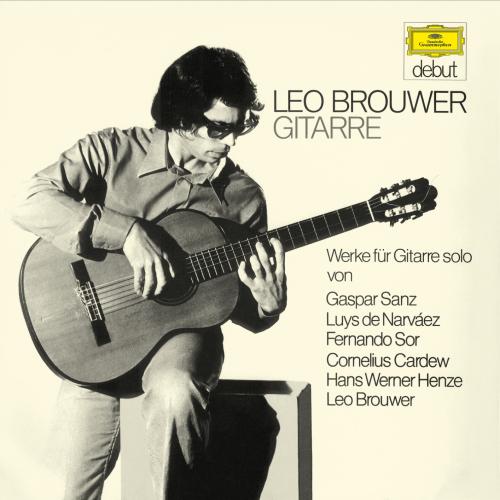
Guitar Solo (Remastered) Leo Brouwer
Album Info
Album Veröffentlichung:
2026
HRA-Veröffentlichung:
30.01.2026
Label: Deutsche Grammophon (DG)
Genre: Guitar
Subgenre: Classical Guitar
Interpret: Leo Brouwer
Komponist: Gaspar Sanz (1640-1710), Luys de Narváez (1505-1549), Fernando Sor (1778-1839), Hans Werner Henze (1926-2012), Leo Brouwer (1939)
Das Album enthält Albumcover
Entschuldigen Sie bitte!
Sehr geehrter HIGHRESAUDIO Besucher,
leider kann das Album zurzeit aufgrund von Länder- und Lizenzbeschränkungen nicht gekauft werden oder uns liegt der offizielle Veröffentlichungstermin für Ihr Land noch nicht vor. Wir aktualisieren unsere Veröffentlichungstermine ein- bis zweimal die Woche. Bitte schauen Sie ab und zu mal wieder rein.
Wir empfehlen Ihnen das Album auf Ihre Merkliste zu setzen.
Wir bedanken uns für Ihr Verständnis und Ihre Geduld.
Ihr, HIGHRESAUDIO
- Gaspar Sanz (1640 - 1710): Instrucción de música sobre la guitarra española, Book II:
- 1 Sanz: Instrucción de música sobre la guitarra española, Book II: No. 7, Matachin 00:46
- 2 Sanz: Instrucción de música sobre la guitarra española, Book I: No. 13, Españoleta 00:53
- 3 Sanz: Instrucción de música sobre la guitarra española, Book II: No. 28, La Cavalleria de Napoles 01:08
- 4 Sanz: Instrucción de música sobre la guitarra española, Book I: No. 35, Canarios 01:10
- 5 Sanz: Instrucción de música sobre la guitarra española, Book I: No. 41, Preludio o capricho arpeado 01:08
- 6 Sanz: Instrucción de música sobre la guitarra española, Book I: No. 43, Alemanda, la Preciosa 02:30
- 7 Sanz: Instrucción de música sobre la guitarra española, Book I: No. 44, Coriente 01:18
- 8 Sanz: Instrucción de música sobre la guitarra española, Book I: No. 22, Zarabanda francesa 01:10
- 9 Sanz: Instrucción de música sobre la guitarra española, Book I: No. 42, Sesquiáltera 00:40
- Luis de Narváez (1490 - 1552): Los seys libros del Delphin:
- 10 Narváez: Los seys libros del Delphin, Book I: Fantasía III. Tercer tono 02:30
- 11 Narváez: Los seys libros del Delphin, Book II: Fantasía XIII. Primer tono por gesolreut 01:20
- Fernando Sor (1778 - 1839): 12 Minuets, Op. 11:
- 12 Sor: 12 Minuets, Op. 11: No. 7 in A Minor 01:54
- 13 Sor: 12 Minuets, Op. 11: No. 6 in A Major 02:00
- 14 Sor: 12 Minuets, Op. 11: No. 5 in D Major 02:20
- 15 Sor: 12 Minuets, Op. 11: No. 3 in G Major 02:58
- 16 Sor: 12 Minuets, Op. 11: No 10 in E Major 02:45
- Cornelius Cardew (1936 - 1981): Material:
- 17 Cardew: Material 05:59
- Hans Werner Henze (1926 - 2012): El Cimarrón, The Autobiography of The Runaway Slave Esteban Montejo:
- 18 Henze: El Cimarrón, The Autobiography of The Runaway Slave Esteban Montejo: Memories 15:29
- Leo Brouwer (b. 1939): Exaedros:
- 19 Brouwer: Exaedros 06:11
Info zu Guitar Solo (Remastered)
Leo Brouwer wurde 1939 in Havanna geboren, und seine Abstammung als Gitarrist lässt sich bis zu Francisco Tárrega (1852–1909) zurückverfolgen. Sein Lehrer war Isaac Nicola, der Begründer der kubanischen Gitarrenschule, selbst ein Schüler von Emilio Pujol, der wiederum bei dem großen Tárrega studiert hatte. 1959 erhielt Brouwer ein Stipendium für einen Kompositionskurs an der Julliard School in New York. Ein Aufenthalt in Warschau veränderte seine Sichtweise auf die Komposition völlig, und der Einfluss der „polnischen Schule” auf ihn und andere kubanische Avantgarde-Künstler war weitreichend. Seine Arbeit umfasste sowohl Ballett als auch Kino und erstreckte sich in den 1960er Jahren auch auf symphonische Werke.
Leo Brouwer, klassische Gitarre
Digital remastered


Juan Leovigildo Brouwer Mezquida
born March 1, 1939 in Cuba. He is a composer, conductor, and classical guitarist. Here’s a great writeup via this Naxos Album: “One of the few Cuban composers to gain international recognition, Leo Brouwer was born in Havana in 1939. He became a fine guitarist and had his first composition published at the age of 17. He subsequently moved to the United States and was enroled in the Juilliard School to study composition. On his return to Havana he worked for the radio and was later appointed composition professor at the Havana Conservatory. Initially we find folk music inspiring his compositions, but he later embraced the most advanced West European avant-garde techniques while founding a new Cuban school of composition. That largely changed at Juilliard where he came under the influences of the most avant garde composers, such as Cage, Nono and Henze, which were to stimulate his later works. He has since written a number of large scale works, including concertos for flute and for guitar, though his name is best known in the field of solo guitar music.”
Dieses Album enthält kein Booklet