

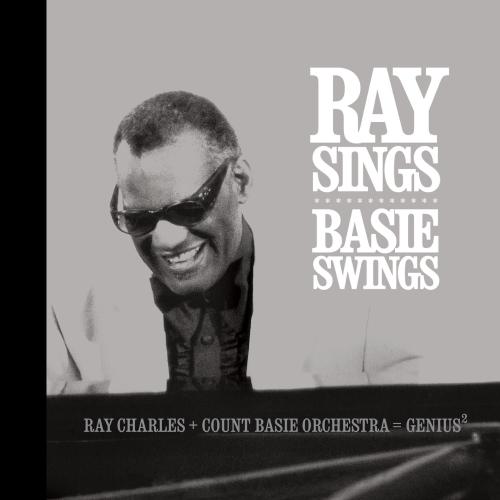
Ray Sings, Basie Swings (Remastered) Ray Charles & The Count Basie Orchestra
Album info
Album-Release:
2006
HRA-Release:
31.03.2026
Album including Album cover
- 1 Oh, What A Beautiful Morning 04:36
- 2 Let The Good Times Roll 02:59
- 3 How Long Has This Been Going On 06:22
- 4 Every Saturday Night 04:08
- 5 Busted 02:36
- 6 Crying Time 03:54
- 7 I Can't Stop Loving You 04:03
- 8 Come Live With Me 04:12
- 9 Feel So Bad 04:12
- 10 The Long and Winding Road 04:06
- 11 Look What They've Done To My Song 02:51
- 12 Georgia On My Mind 04:38
Info for Ray Sings, Basie Swings (Remastered)
Originally released by Concord Records, Ray Sings, Basie Swings combined previously unreleased Ray Charles vocal performances from the 1970s with then-newly recorded instrumental tracks by the contemporary Count Basie Orchestra.
In 2005, then Concord Records head John Burk (producer of Ray Charles’ August 2004 Grammy-winning collaboration album Genius Loves Company, a record that’s also a personal favorite of mine, btw!) found a reel of tape simply labeled “Ray/Basie.” Said Burk, “I was immediately excited as there were no prior recordings of Ray Charles with the Basie band ... and I practically ran to put the tapes on the machine.”
Alas, what Burk heard on that reel wasn’t Basie and Charles playing together, but rather separate sets during concerts Ray performed in Germany and England. Even so, unknown live recordings of Ray Charles from the 1970s was cause for excitement. Said recording of Ray’s band was obscured by a bad mix, leaving only Charles’ vocal performance audible. At first, the thought was this potentially momentous discovery would be unusable until Burk had the idea to bring the contemporary Count Basie Orchestra into the studio to lay down newly recorded instrumental tracks behind Charles’ vocals. (Basie himself had passed away in 1984, while Charles had passed in 2004, just a few months prior to the release of the aforementioned Genius Loves Company.)
Ray Charles loved Count Basie, and had used Basie’s arrangements as a blueprint for his own arrangements. According to Sid Feller, who probably wrote more Ray Charles big band orchestrations than anyone, Charles would “often point to Basie charts as templates. He wanted that thick harmony in the reeds. He wanted those clean horn punches. He wanted it simple like Basie, and he wanted it strong. Mostly, though, he wanted that Basie swing.”
Charles is heard in top form on these remakes of his early ABC-Paramount-era hits, and other of-era material. The consecutive reworkings of “Busted,” “Crying Time,” and “I Can’t Stop Loving You,” three of his defining Top Ten hits of the early ’60s, are given brassy, bluesy treatments here.
Standards ranging from Richard Rodgers and Oscar Hammerstein II’s “Oh, What a Beautiful Morning” to The Beatles’ “The Long and Winding Road” are transformed in Charles’ hands. The set-closing “Georgia on My Mind,” as close to a signature song as Charles ever had, is given a tender, minimalist reading. Meanwhile, the cut preceding it, “Look What They’ve Done to My Song,” a cover of a fine track by noted folk-pop singer Melanie, is also a highlight of the album.
Burk and his co-producers decided on a single goal: to make Ray Sings, Basie Swings sound like a genuine, heart-to-heart collaboration (their words). To create the impression that the music on Ray Sings, Basie Swings was actually performed together, the editing process took the production team four months, all told. The end result is certainly a compelling collaboration, even if it didn’t happen in real time.
"Ray Sings, Basie Swings, huh? Hmm, well, yes and no. You see, the story goes something like this. In 2005, Concord Records exec John Burk, who produced Ray Charles' superb late-career, Grammy-winning Genius Loves Company, found a reel of tape simply labeled "Ray/Basie." Upon further analysis, it was determined that the 1973 recording featured Ray Charles backed by his own band -- Count Basie and his band had actually recorded earlier that day. Charles' vocal was exceptionally prominent in the mix and at first it was thought that this potentially momentous discovery would prove unable to bear fruit. But then Burk brainstormed and decided to bring the current Count Basie Orchestra -- whose leader died in 1984 -- into the studio to lay tracks behind Charles' vocals. So there's no Basie on Ray Sings, Basie Swings, but that's merely a technicality, because there is some great music. Charles was in fine form vocally on this mix of remakes of his early ABC-Paramount-era hits and then-recent material. The consecutive reworkings of "Busted," "Cryin' Time," and "I Can't Stop Loving You," three of his defining Top Ten hits of the early '60s, are given brassy, bluesy treatments here, and standards ranging from Oscar Hammerstein II's "Oh, What a Beautiful Morning" to the Beatles' "The Long and Winding Road" are transformed in Charles' hands. The set-closing "Georgia on My Mind," as close to a signature song as Charles had, is given a tender, minimalist reading, but the track preceding it, "Look What They've Done to My Song, Ma," picked up from the folk-pop singer Melanie, is quite possibly the album's highlight. It's appeared on other Ray Charles compilations before, but the gospelized, testifyin' version featured here has got to be the liveliest take on that song anyone's ever devised. So, yeah, there's no Count Basie to be found here, but his namesake orchestra does him proud. For one of those postmortem studio patch jobs that owes as much to technology as talent, it's a fine addition to the Ray Charles oeuvre, as long as one can get past the semi-false advertising of its title." (Jeff Tamarkin, AMG)
Ray Charles, vocals, piano
Marshall McDonald, lead alto saxophone, flute
Grant Langford, 2nd alto saxophone
Doug Lawrence, 1st tenor saxophone
Doug Miller, 2nd tenor saxophone
John Williams, baritone saxophone
Dave Keim, lead trombone
Clarence Banks, 2nd trombone
Alvin Walker, 3rd trombone
Barry Cooper, bass trombone
Mike Williams, lead trumpet
Scotty Barnhart, 2nd trumpet
Shawn Edmonds, 3rd trumpet
Endré Rice, 4th trumpet
Joey DeFrancesco, organ
Tony Suggs, piano
James Leary, double bass
Will Matthews, guitar
Butch Miles, drums
Patti Austin, backing vocals
Maxi Anderson, backing vocals
Lynne Fiddmont, backing vocals
Lorraine Perry, backing vocals
Sharon Perry, backing vocals
Darlene Perry, backing vocals
Valerie Pinkston, backing vocals
Sandy Simmons, backing vocals
Digitally remastered

Ray Charles
was a legendary musician often called the "Genius,” who pioneered the genre of soul music during the 1950s.
Charles combined blues, gospel, R&B, rock, country music and jazz to create groundbreaking hits such as “Unchain My Heart,” “I’ve Got A Woman” and “What I’d Say.” His impressive multi-award winning 50-year career left an indelible mark on contemporary music all over the world.
Born Ray Charles Robinson on September 23, 1930, in Albany, Georgia, he was raised in Greenville, Florida, and started playing the piano before he was five. At age six, he contracted glaucoma that eventually left him blind. He studied composition (writing music in Braille) and learned to play the alto saxophone, clarinet, trumpet, and organ while attending the St. Augustine School for the Deaf and the Blind from 1937 to 1945. His father died when he was 10, his mother five years later, and he left school to work in dance bands around Florida, dropping his last name to avoid confusion with boxer Sugar Ray Robinson. In 1947, with $600 he moved to Seattle and worked as a Nat “King” Cole-style crooner.
Ray often said, “I was born with music inside me. That’s the only explanation I know.”
In the decades after Seattle, Ray Charles continued his contributions to the many facets of music in which he excelled. His numerous awards include 8 honorary doctoral degrees, 17 GRAMMYs, the GRAMMY Lifetime Achievement Award, President’s Merit Award, Kennedy Center Honors, National Medal of the Arts and his Playboy Awards. Heads of State, Presidents, Political Dignitaries and members of Royal families have recognized him repeatedly. The King and Queen of Sweden chose him to receive the Polar Music Award, which is that country’s most prestigious award. Rolling Stone Magazine ranked him #10 on their list of the “100 Greatest Artists of All Time” and #2 on their list of the “100 Greatest Singers of All Time.” And in 2013 Ray Charles even received a United States Postal Stamp.
One his warmest compliments came from the “Chairman of the Board” Frank Sinatra, who gave him the name “Genius” “the only true Genius in show business.”
Throughout his career, Charles was active in a range of political and humanitarian causes.
In 1986, Ray Charles formed The Robinson Foundation for Hearing Disorders, Inc., with a $1 million personal endowment. The Robinson Foundation for Hearing Disorders, Inc. later changed its name to The Ray Charles Foundation. The Foundation is dedicated to providing support in the area of hearing disorders and the empowerment of young people through education by offering support to educational institutions and non-profit education programs. Ray Charles said: “The inability to hear is a handicap; not the inability to see.” The vision of The Ray Charles Foundation is to instill in the youth of America that “there is no challenge too great one cannot overcome.”
Of All the hundreds of songs he recorded, Ray Charles’ rendition of “America the Beautiful” remains to this day the definitive version of that song.
It exceeds all others in its ability to lift our collective spirits.
Ray Charles recorded the song in 1972. In live performances he followed a consistent pattern, of improvisations we associate with gospel and soul music. He added, “I’m talkin’ about America” and “I love America, and you should too,” and “Sweet America,” all passionate accents that indelibly marked the song as a personal tribute to the country he loved so much.
Ray Charles performed “America the Beautiful” on national and international world stages, all by popular demand, from the Major League Baseball World Series to NFL Superbowls, and both summer and winter Olympics. Ray’s “America the Beautiful” hits the right tone of brotherhood and patriotism unlike any other song. It remains one of Ray Charles’ most requested songs, first introduced at his stage show at Carnegie Hall with the unfurling of a giant American flag.
In Ray Charles’ voice the original poem, written in 1893 by Katharine Lee Bates, comes alive to paint the story of the country she envisioned. The canvas is the heart of the people and Ray Charles takes his time with each phrase, carefully crafting a masterpiece in every performance. Arranged by his longtime friend Quincy Jones, Ray Charles sings and swings, hums and prays, and invites the audience to sing along and they do, in a call-and-response pattern familiar in many churches. It is a powerful expression of unity, community, and love of country. A seminal example of his magnetism was the 1984 Republican National Convention where Ray Charles delivered his gospel version of “America the Beautiful” filling the captivated audience with tears of awe and joy!
Ray Charles truly popularized the song over decades, following its debut on his groundbreaking album, A Message from the People. When asked about his interpretation, Ray Charles simply said: “I put a little country backbeat on it and turned it my way.” Amen, Brother Ray.
This album contains no booklet.