


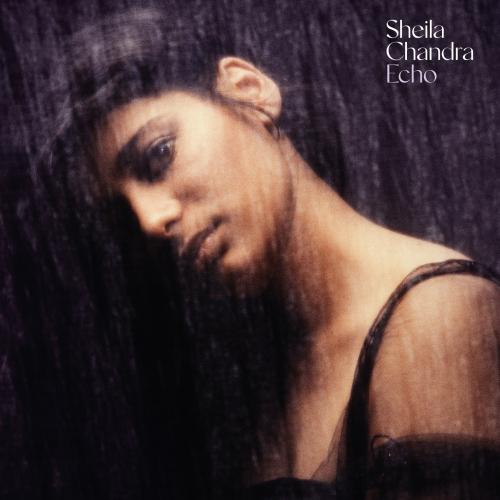
Echo Sheila Chandra
Album Info
Album Veröffentlichung:
2026
HRA-Veröffentlichung:
25.09.2026
Das Album enthält Albumcover
- 1 Speaking in Tongues III (Live) 02:18
- 2 Ever So Lonely / Eyes / Ocean (Live) 04:49
- 3 Dhyana and Donalogue (Live) 04:11
- 4 The Enchantment (Live) 04:32
- 5 Waiting (Live) 06:14
- 6 Speaking in Tongues II (Live) 03:06
- 7 Lament of McCrimmon / Song of the Banshee (Live) 05:57
- 8 Mecca (Live) 03:27
- 9 Sacred Stones (Live) 05:26
- 10 The Blacksmith (Live) 03:25
- 11 Speaking in Tongues I (Live) 01:55
- 12 Nana / The Dreaming / Fine Horseman (Live) 08:28
- 13 Speaking in Tongues IV (Live) 04:04
- 14 Shehnai Song (Live) 01:45
- 15 Sailor's Life (Live) 04:38
- 16 Shanti Shanti Shanti (Live) 00:54
Info zu Echo
This live album’s title loosely references the nymph of Greek myth who lost her voice – just as Sheila Chandra did 15 years ago. And it takes its emotional arc from her narrative.
Echo was cursed by the Goddess Hera who took her ability to voice her own thoughts, and condemned her to repeat only the last words spoken to her. This collection follows the emotional journey Echo found herself on afterwards, as she fell in love with Narcissus, and spurned by him in favour of his own reflection in a pool, faded away with grief into the hills until only her voice was left.
Though not lyrically tied to the myth, the songs mirror the stages of Echo’s love and loss. They take us from a woman self-contained and at peace, feeling attraction, and then moving through longing, obsession, devoted love, to tragedy, agony, depression and despair.
“Putting together an album of live performances is quite a challenge for a shy studio perfectionist like myself. The temptation is always to go for technical excellence. The trouble is, that’s not what live performance is about.
I was quite ‘old’ as a performer when I realised this. Live performance was something I came to after spending 10 years as an exclusively studio artist, and only then because I was beginning to feel a bit of a fake because I’d never done it. As most people who’ve followed my career know by now, I decided that I really wanted to ‘crack’ the secret of good stage presence – something I knew absolutely nothing about. And that, I realised, was something I could never be sure I’d mastered, while hiding behind a band. This decision taken, it was clear my first live performances had to be given entirely solo. It also saved me from grappling with the logistics of hiring a band – which I also knew nothing about – and having my attention taken up with that, rather than the performances themselves.
I’d also had that experience which I think many child performers do, of being asked to do a ‘turn’ for friends or family. It happened when I first visited India – around the time that the highly glossy, (48 stem/track) global hit version of ‘Ever So Lonely’ with its multiple layers of percussion, piano and sitar had just been in the charts. I sang an ordinary pop song for them (I’ve forgotten which one) since that was the only vocal technique I was familiar with at that time– and which of course, my tiny informal audience in Chennai didn’t know. They couldn’t ‘hear’ the chords which went alongside the song in their heads as I could, while I sang. Every performer of whatever age, is constantly noting how their performance is being received, and I felt the effect was rather ‘flat’. And that this was going to be a perennial problem for me, as singers in the West are almost always backed up by chords which change the emotional colour of what they’re singing. It was there and then, at 17, that I resolved to find a way to create an entire ‘world’ for the listener when I sang alone and unaccompanied. I wanted to be able to rock up and do that anywhere at any time, with no help whatsoever.
And of course, 10 years later, I wrote a trilogy of albums in order to perform solo, which consisted entirely of solo voice or solo voice and drone tracks. Solo voice tracks meant producing a fusion within the melodic line I was singing – another technical challenge I needed to solve. Prior to that I had simply juxtaposed various global vocal techniques I’d learned, by putting them side by side on tracks like ‘Lament of McCrimmon/Song of the Banshee’. (‘McCrimmon’ and ‘Mecca’ are two songs from the album that came just before the trilogy, where I was experimenting with solo voice and drone, so I included them my first ‘live’ sets, and here too.) The breakthrough came when I was singing ‘Dhyana and Donalogue’ one evening, and my voice just flew off into the Arabic style melisma on the last verse. That’s when I knew I had it!
I’d never been an avid concert goer, and most of the concerts I’d been to consisted of English folk, or Indian Classical music and dance. While I very much enjoyed the performances I saw, being such an introvert, and probably autistic and overly sensitive to lots of sound, I didn’t entirely ‘get it’.
Then I started to observe that both I and other skilled musicians often didn’t notice when the performer made a mistake. This was very strange. And I felt that ‘something else’ was being communicated; something more important than singing all the right notes. When my voice deteriorated, I was overcome with terrible stage fright (as anyone who is standing in front of an audience, with realistic fears that their voice won’t work properly, would). But in the overcoming of this, I came to see that I needed to sing differently for a live audience. That my performances were co-created, by my audience and myself, and that it’s a performer’s presence and heart that an audience come to hear, not technical perfection. Concerts are one of the few places where another person gives us their undivided, undistracted and ‘in the moment’ presence, and we, as audience, ‘borrow’ their stilled mind. It’s one of the vanishingly few spaces in our society where that still happens.
The performances embodied on this album, reflect that truth. They are not perfect. And sustaining 100% focused concentration when you’re carrying an entire show alone is impossible. There are inevitably going to be a few ‘micro-second’ lapses. In some cases, I had access to performances of the same song with greater technical perfection, but less ‘soul’. In every case, I have chosen feeling over precision – even, in some cases, chosen ‘soul’ over the best available recording quality. That said, listening to an album is not the same as being at a live performance, and the listener will pick up on technical flaws, so it’s a balance. But I’ve tried to ignore the impulse to ‘change history’.
To begin with, I collected and listened to every fairly decent quality recording of every performance I ever gave, regardless of copyright owner or source, and Real World (particularly Oran Mullan) helped me hugely in that process. All the performances here were recorded in a single take, either at a concert, or a radio session (where effectively the programme presenter and crew are your ‘audience’, though they tend not to clap in case they ruin the take).
In the interests of making a passionate performance (or sometimes the only recorded live performance of a song) usable, I have asked my talented mix engineer Stuart Bruce, to autotune just two notes in total on this album. (I leave you to guess which two.) And of course, to cut out clicks, pops, mouth noises etc., to add some effects where I felt they were needed (as some of the recordings of the performances were simply dry vocals from the desk, recorded purely for reference), and to enhance the original sound of recordings to produce a cohesive listening experience. Stuart was the mix engineer on the original trilogy, so of course he was the perfect person to ask!
My thanks go to all the radio and TV people who forced a reluctant, slightly grumpy me to give performances that were recorded. This especially includes John Diliberto from ‘Echoes’ in the USA, who came to my little rented cottage in Somerset in 1993 to record a ‘living room concert’ – which I really, really didn’t want to do – and from which session ‘Ever So Lonely/Eyes/Ocean’ and ‘Dhyana and Donalogue’ are included here. In my ‘studio artist’ mindset, they never seemed good enough at the time, but old recordings are a bit like old photographs. Sometimes you find one and think, ‘Why was I ever dissatisfied with that?’
I gave very few concerts in comparison to most artists. And the most common comment I see from fans on social media is ‘Big regret that I never got to see her ‘live!’. Now I hope, you can close your eyes and feel yourself there, in the front row….”
Sheila Chandra
Produced by Sheila Chandra and mixed by Stuart Bruce at Bruce Audio.
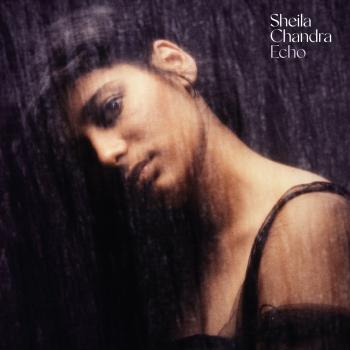
Sheila Chandra
Born in South London to a South Indian immigrant family, Sheila Chandra discovered her voice at the age of twelve and whilst at Theatre Arts school. From this moment her chosen path was to be a singer.
Lacking any real contacts or access to the music business, she nevertheless honed her vocal skills as a labour of love, spending up to two hours a night throwing her voice into the tall, draughty and uncarpeted stairwell of the family home: “I didn’t know how to manufacture an opportunity, but I was determined that when a chance came my way I would be ready.”
A chance did come her way, perhaps drawn by the weight of such unshakable belief. Steve Coe, a writer and record producer, was about to form a band, Monsoon, as an outlet for his increasingly Indian influenced material. He came across Chandra’s voice on an old audition tape, lying in a box at Hansa Records and knew that he had found his singer: “The richness, fluidity and quality of her voice struck me immediately. And then when I requested a photo from the file and found that Sheila was Asian, everything else seemed to fall into place.”
Monsoon put out an EP on Steve Coe’s newly formed Indipop label and were signed by the far sighted Dave Bates at Phonogram. The band’s first single ‘Ever So Lonely’ took a song written around a raga and, utilising the new production techniques available, came up with an irresistible but radical modern pop fusion sound. It was a top ten hit and notched up a quarter of a million sales worldwide.
Following singles did not manage to dent the top twenty and six months later Chandra walked away from it all, frustrated by the increasing lack of communication between Phonogram and Monsoon over artistic direction. She went back to the Indipop label to learn her craft as a writer and musician. Free from business constraints and in complete control of her creative life, there followed a remarkable and prolific two-year period. Her first four solo albums for the label chronicle a profound transformation in the quality and depth of her work, both as a singer and increasingly as a writer, in her then chosen field of Asian fusion— learning from the very structures she had ignored throughout her childhood.
Her new found ability to cross continents in a single vocal line and weave seamlessly the vocal styles of the Arab world, Andalucia, Ireland, Scotland, India and more ancient structures such as that of Gregorian plainsong made for a true fusion within one mind and one voice. Weaving My Ancestor’s Voices established Chandra as a spiritual heir to a ‘whole world’ vocal tradition, whilst Coe’s sensitive and painstaking production enhanced this further and acted as an integral part of the recording, particularly on the virtuoso vocal percussion pieces ‘Speaking In Tongues’ I and II. The album spent several weeks in the Billboard World Music Top 10 and outsold everything else on the label in the USA.
After touring the USA with Peter Gabriel’s 1993 WOMAD tour, there followed The Zen Kiss and ABoneCroneDrone. The latter was a daring minimalist strategy to lure the listener out of long accustomed passivity to hear, as Chandra does, the living symphony of harmonics within the simplest of drones.
In 2001, Sheila released a one-off collaboration album with The Ganges Orchestra called This Sentence is True (The Previous Sentence Is False) on the tiny Indipop Records; a project she said helped her break out of her voice and drone box. In the meantime, Sheila’s transcendent vocals from the Real World trilogy had became a staple ingredient of unauthorised dance remixes, and were even copied by session singer Shahin Badar for the infamous single ‘Smack My Bitch Up’ by The Prodigy, in 1997.
Fiercely protective of her musical vision, she’s always received numerous requests to allow samples and remixes of her work, and almost always refuses. However, in 2002, fresh from their success with ‘American Dream’, Jakatta used Sheila’s 1982 Top Ten hit ‘Ever So Lonely’ vocals and completely reconstructed the track underneath. The resulting single reached no 8 in the UK charts and Sheila appeared on Top Of The Pops for the second time. She was also one of four soloists on the second Lord Of The Rings film soundtrack, The Two Towers in 2002 (with a piece written especially for her called ‘Breath Of Life’) which went platinum.
Following voice problems, Sheila returned to live performances for a short while in 2007, after a gap of 14 years, giving concerts around the world with WOMAD and other festivals. She also featured on the first Imagined Village album in that year, and toured the UK with them. In 2010 she signed her first book to Vermilion (Random House) entitled Banish Clutter Forever— How the toothbrush principle will change your life.
Unfortunately this innovative artist’s voice has continued to deteriorate. In 2010 Sheila developed Burnt Mouth Syndrome (for which there is no known cause or cure) and now experiences long-lasting neurological pain triggered by speaking. Singing is completely out of the question. She is effectively mute, and communicates in person largely through handwritten notes and very basic sign language. She says she considers the trilogy she made for Real World to be the best work of her musical career.
Dieses Album enthält kein Booklet