

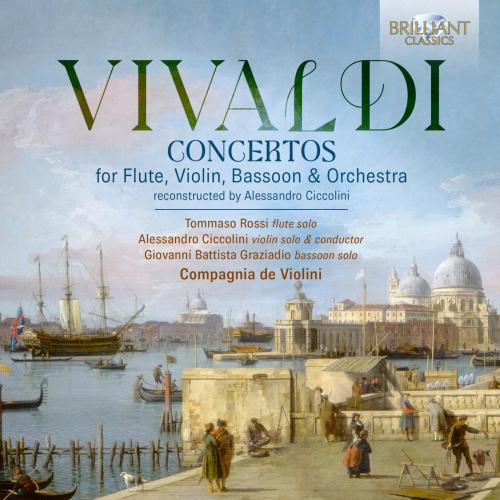
Vivaldi Concertos for Flute, Violin, Bassoon & Orchestra Tommaso Rossi, Alessandro Ciccolini, Giovanni Battista Graziadio, Compagnia de Violini
Album Info
Album Veröffentlichung:
2026
HRA-Veröffentlichung:
25.02.2026
Label: Brilliant Classics
Genre: Classical
Subgenre: Concertos
Interpret: Tommaso Rossi, Alessandro Ciccolini, Giovanni Battista Graziadio, Compagnia de Violini
Komponist: Antonio Vivaldi (1678-1741)
Das Album enthält Albumcover
- Antonio Vivaldi (1678 - 1741): Violin Concerto in B-Flat Major, RV 378:
- 1 Vivaldi: Violin Concerto in B-Flat Major, RV 378: I. Allegro 05:57
- 2 Vivaldi: Violin Concerto in B-Flat Major, RV 378: II. Adagio 05:18
- 3 Vivaldi: Violin Concerto in B-Flat Major, RV 378: III. Allegro Molto 04:17
- Bassoon Concerto in D Minor, RV 482:
- 4 Vivaldi: Bassoon Concerto in D Minor, RV 482: I. Allegro Molto 02:45
- 5 Vivaldi: Bassoon Concerto in D Minor, RV 482: II. Largo-Presto-Largo-Presto-Largo 04:15
- 6 Vivaldi: Bassoon Concerto in D Minor, RV 482: III. Allegro Mà Non Molto 03:39
- Flute Concerto in E Minor, RV 432:
- 7 Vivaldi: Flute Concerto in E Minor, RV 432: I. Allegro 03:18
- 8 Vivaldi: Flute Concerto in E Minor, RV 432: II. Grave 04:35
- 9 Vivaldi: Flute Concerto in E Minor, RV 432: III. Allegro 04:15
- Bassoon Concerto in C Major, RV 468:
- 10 Vivaldi: Bassoon Concerto in C Major, RV 468: I. Allegro Molto 02:33
- 11 Vivaldi: Bassoon Concerto in C Major, RV 468: II. Andante 01:28
- 12 Vivaldi: Bassoon Concerto in C Major, RV 468: III. Allegro 04:41
- Flute Concerto in E Minor, RV 431:
- 13 Vivaldi: Flute Concerto in E Minor, RV 431: II. Grave 04:35
- Violin Concerto in G Minor, RV 320:
- 14 Vivaldi: Violin Concerto in G Minor, RV 320: III. Allegro Non Molto 05:22
Info zu Vivaldi Concertos for Flute, Violin, Bassoon & Orchestra
Antonio Vivaldi (1678–1741) war ein italienischer Barockkomponist, virtuoser Geiger und Priester, der vor allem für seine dynamischen Instrumentalkonzerte und seine innovativen Orchesterkompositionen bekannt ist. Der in Venedig geborene Vivaldi wurde sowohl in Musik als auch in Theologie ausgebildet und wurde schließlich Geigenlehrer und Komponist am Ospedale della Pietà, einem Waisenhaus für Mädchen mit einem außergewöhnlichen Musikprogramm. Während seiner Zeit dort schuf er viele seiner besten Instrumentalwerke und trug zur Prägung des unverwechselbaren venezianischen Barockstils bei.
Tommaso Rossi, Flöte
Alessandro Ciccolini, Violine & Leitung
Giovanni Battista Graziadio, Fagott
Compagnia de Violini
Tommaso Rossi
graduated in flute at the Conservatory of Naples, under the guidance of Pasquale Esposito, and then perfected with Mario Ancillotti at the Fiesole School of Music, where he received his diploma with honors. He received his flute diploma with honors, and honorable mention under the guidance of Paolo Capirci at the Conservatory of Latina, specializing with Pedro Memelsdorff in recorder and Jesper Christensen in Chamber Music at the Schola Cantorum Basiliensis.
He participates regularly to concerts and recordings of I Turchini directed by Antonio Florio (now Cappella Neapolitana) with whom he recorded for Opus 111, Naïve, Eloquentia, Dynamic, gloss and has performed as a soloist in many international festivals (Utrecht, Barcelona, Schleswig-Holstein, Seville, Bremen, Ambronay, Lisbon, Halle, Brussels, Mexico City, Paris, Cairo, Rabat, Madrid, Bergen, Vienna, Brussels, Settembre Musica of Turin, Accademia di Santa Cecilia, the Friends of Music of Palermo , Teatro San Carlo, Associatione A. Scarlatti, GOG, Amici della Musica di Perugia, the Zagreb Festival, Accademia Filarmonica di Verona, Copenhagen Renaissance Festival, Opera of Lausanne).
He also collaborated with Il Complesso Barocco directed by Alan Curtis and Ensemble Risonanze directed by Carlo Chiarappa.
In 2010 he founded the Ensemble Barocco di Napoli, with whom published the complete Alessandro Scarlatti cantatas for soprano, flute and basso continuo and, in 2013, and the first recording of sonatas by Leonardo Leo for flute and basso continuo.
He has recorded with Ensemble Dolce & Tempesta concerts by Nicola Fiorenza for recorder and recently published for the label Stradivarius the 12 Fantasies by Georg Philipp Telemann.
He dedicates himself as a performer and organizer for years even to contemporary repertoire. It is a founding partner and president of Associazione Dissonanzen in Naples. With Ensemble Dissonanzen, the Association’s production organism, has performed for italian and international musical institutions such as the Ravello Festival, Festival Time Zones, Trajectories of Parma, Ravenna Festival, the Friends of Music of Modena, Scarlatti Association of Naples, the GOG Genoa, the Guggenheim Museum in New York, the Italian Film Festival of Annecy, the Salzburg Festival. He recorded with Ensemble Dissonanzen cds for Niccolò, Mode Records, Die Schachtel.
He teaches recorder at the Conservatory of Music of Cosenza where he was for three years (2012-2014) scientific curator of the international advanced training project “La Follia”, which involved the Conservatory of The Hague, Lisbon, Porto, Riga, Copenhagen, Corfu, Malmoe, Weimar.
Graduated with honors in history of music at the “Federico II” University of Naples, his contributions have appeared in many italian magazines.
Since June 2016 he has been artistic director of the Associatione “Alessandro Scarlatti” in Naples.
Alessandro Ciccolini
A baroque violinist, he worked for several years as first violin with La Cappella della Pietà dei Turchini in Naples, and currently continues his collaboration with maestro A. Florio as concertmaster of the ensemble I Turchini, performing in major concert halls and festivals around the world. He has also collaborated with the most renowned early music ensembles, including “Concerto Soave” in Marseille and “Il Complesso Barocco” conducted by A. Curtis.
On October 16, 1994, a concert was organized at Stift Rein, near the city of Graz, with a program consisting entirely of his own compositions, written for the occasion, which were very well received. Since then, his work as a composer and reviser has been inseparable from his work as a violinist.
He edited the oratorio “Assalonne Punito” by P. A. Ziani, composing the instrumental parts that had been lost. This version was performed in 1997 in Naples, in 1998 in Piacenza and in Berlin by the ensemble “Il Complesso Barocco” conducted by Maestro A. Curtis. In 2005, the same American maestro commissioned him to reconstruct A. Vivaldi's recently rediscovered opera “Motezuma.” This reconstruction was recorded in 2006 for Deutsche Grammophon and published in 2010 by the Baerenreiter publishing house.
In July 2006, the Festival dei Due Mondi in Spoleto staged his reconstruction of A. Vivaldi's opera “Ercole sul Termodonte” under the direction of Maestro A. Curtis.
He reconstructed the comic parts of Domenico Scarlatti's opera “Ottavia restituita al trono,” performed under the direction of A. Florio at the Victoria Eugenia Theater in San Sebastian during the “Quincena musical 2007.”
From 2010 to 2013, he conducted the Orfeo Futuro orchestra, performing J.S. Bach's Magnificat and his own compositions, including: a Laudate Dominum for soprano, choir, and orchestra; a Salve Regina for soprano and strings; a cantata for soprano and instruments, Ero e Leandro, also performed at the XV Festival Musicale Estense Grandezze e Meraviglie in Modena and later at the Anima Mea festival in Molfetta; and a Lezione del Mercoledì Santo for soprano, contralto, and strings.
In 2013, the French record label Naive recorded his reconstruction of A. Vivaldi's opera “Catone in Utica” for the Vivaldi Edition, conducted by maestro A. Curtis; it was subsequently published by the American publishing house Boosey & Hawkes.
In 2017, he conducted the first performance of his “Stabat Mater” for soprano, contralto, and orchestra in Lodi for the association “La Lira d'Orfeo,” and his Salve Regina for three sopranos and orchestra was performed at the Palau de la Musica in Valencia by the “Capella de Ministrers” conducted by Carles Magraner.
He has recorded for: Accent, Harmonia Mundi, Opus 111, Stradivarius, Tactus, ORF, BBC, RAI 1, and RAI 3.
For the Symphonia record label, he has recorded two CDs containing compositions performed for the first time in the modern era: “Il primo libro delle sonate di violino del Sig. Aldebrando Subissati sonator Famosissimo, Fossombrone 1675” released in 1997 and “Concerti da chiesa a quattro stromenti op II, Casalmaggiore 1729” by composer Andrea Zani, released in 1998.
For the Brilliant Classics record label, in 2011, he recorded a CD containing the Sonatas opera Quarta by T. Albinoni and in 2016 a CD containing the first recording in the modern era of the sonatas opera quarta by Pietro Degli Antoni.
Together with harpsichordist Francesco Baroni and talented young musicians, he founded the Compagnia de Violini ensemble, whose aim is to bring the wonderful Italian instrumental repertoire of the 17th and 18th centuries to today's audience through rigorous philological research.
He teaches Baroque violin at the A. Boito Conservatory in Parma.
Giovanni Battista Graziadio
first studied recorder and transverse flute at the Early Music Department of the Cosenza Conservatory of Music, graduating with highest honors. He then studied historical bassoon instruments with Maurizio Barigione, Giorgio Mandolesi, and Alberto Grazzi. He completed his master's degree in performance practice and pedagogy for historical bassoon at the Schola Cantorum Basiliensis with Donna Agrell.
He is a founding member of various ensembles: Abchordis (five voices and instruments), The Italian Consort (specializing in Renaissance music), and La Petite Écurie (oboe band for baroque repertoire for double reed ensemble).
Giovanni Battista Graziadio has played and continues to play in many renowned orchestras, such as Concerto Romano, I Barocchisti, Lautten Compagney from Berlin, Freiburger Barockorchester, Orchester La Scintilla, and La Cetra Barockorchester. From 2006 to the present, he has recorded over fourteen CDs, which have been released on various labels such as RADICI MUSIC, Pan Classics, Sony DHM, Erato, and Egea Music.
He also conducts research at the Schola Cantorum Basiliensis as part of the Swiss National Science Foundation-funded project “Fagottini and Teneroons” and is a doctoral student at the University of Basel.
Norihito Nishinomura was born in Aichi Prefecture, Japan, in 1986 and began playing the bassoon at the age of 15. From 2004 to 2008, he studied at Aichi University of the Arts. After completing his bachelor's degree, he continued his studies in 2009 with Prof. Matthias Racz (bassoon) and Gerd Vosseler and Hans Agreda (contrabassoon) at the Zurich University of the Arts. In 2011, he completed his Master of Arts in Music Performance with a concert diploma, followed by a soloist diploma in 2014.
In the summer of 2008, he took part in Seiji Ozawa's opera project “Die Fledermaus” and played in the “Opera for Young People” at the Saito Kinen Festival. While still a student, he became an accredited substitute member of the Tonhalle Orchestra Zurich. Since the 2012/2013 season, he has been deputy principal bassoonist and contrabassoonist with the Bern Symphony Orchestra.
He has been teaching contrabassoon at the Bern University of the Arts since 2014.
Dieses Album enthält kein Booklet