



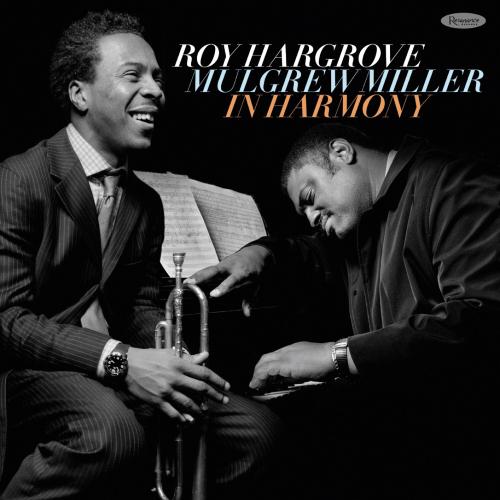
In Harmony (Live) Roy Hargrove & Mulgrew Miller
Album Info
Album Veröffentlichung:
2021
HRA-Veröffentlichung:
28.07.2026
Label: Resonance Records
Genre: Jazz
Subgenre: Contemporary Jazz
Interpret: Roy Hargrove & Mulgrew Miller
Das Album enthält Albumcover
- 1 What Is This Thing Called Love? (Live) 09:09
- 2 This Is Always (Live) 08:22
- 3 I Remember Clifford (Live) 08:34
- 4 Triste (Live) 08:34
- 5 Invitation (Live) 08:02
- 6 Con Alma (Live) 09:43
- 7 Never Let Me Go (Live) 08:27
- 8 Just in Time (Live) 09:09
- 9 Fungii Mama (Live) 06:56
- 10 Monk's Dream (Live) 05:55
- 11 Ruby, My Dear (Live) 07:26
- 12 Blues for Mr. Hill (Live) 07:34
- 13 O.W. (Encore) 05:09
Info zu In Harmony (Live)
"In Harmony" is a stunning set of live performances by Roy Hargrove on trumpet and Mulgrew Miller on piano. In Harmony provides a rare glimpse of these two now departed and dearly missed greats, united in song and improvisational mastery in front of audiences at Merkin Hall in New York City (January 15, 2006) and Lafayette College in Easton, Pennsylvania (November 9, 2007).
Co-produced by Zev Feldman and Larry Clothier with executive producer, George Klabin, In Harmony is the first posthumous Hargrove release since the trumpeter’s untimely passing on November 2, 2018 at age 49. Aida Brandes-Hargrove, President of Roy Hargrove Legacy, said: “Roy’s daughter Kamala and I are excited to collaborate with Resonance and to get this great new album out to Roy’s many fans.”
Miller passed away on May 29, 2013 at age 57. With In Harmony, we are back in the musical company of these two greats for a short but precious time. And though the settings heard here were ticketed concerts, the vibe unfolds exactly as it might have back in the day at Bradley’s, when Hargrove was first coming up in the late ’80s and Miller loomed large from his associations with Art Blakey, Tony Williams and others. Acclaimed jazz journalist Ted Panken, in his extensive booklet essay for In Harmony, evokes that scene, and its central importance to Hargrove’s development, in vivid detail.
Hargrove told Panken, “Bradley’s was like going to school. It was like your masters. You go in there, and you’re playing, and there’s Freddie Hubbard at the bar! What do you do? Everything I’m playing right now I owe to that whole scene.”
Hargrove hailed from Texas, Miller from Mississippi. Each of them drank deep from the Black music traditions of their respective regions, absorbing lessons from family, the church, and blues and soul artists long before they became immersed in the language of their jazz forebears. In Harmony finds the two alluding to those great jazz legacies in many ways, from song choices to improvisational flourishes to off-the-cuff yet impeccably placed arranging details.
We hear Hargrove calling out to Clifford Brown, Dizzy Gillespie, Blue Mitchell, and more. Yet he plays from the perspective of a prescient bandleader who burst through genre boundaries collaborating with leading lights of hip-hop, neo-soul and Afro-Cuban music, laying the groundwork for such next-generation trumpeters as Keyon Harrold and Theo Croker (both of whom are quoted in the booklet as well).
Miller, as Panken observes, had his own “fluid personal argot,” even as he drew on influences from Bill Evans, McCoy Tyner, Herbie Hancock, Chick Corea and Keith Jarrett to Woody Shaw. “His concept drew on piano-as-orchestra signposts like Art Tatum, Oscar Peterson, Ahmad Jamal and Erroll Garner, the ‘blowing piano’ of Bud Powell, the disjunctive syncopations and voicings of Thelonious Monk, and the melodic ingenuity of gurus like Hank Jones, Tommy Flanagan and Cedar Walton,” Panken adds.
It’s all there, in the bright tempos of “What Is This Thing Called Love” and “Invitation,” the majestic balladry of “I Remember Clifford” and “Never Let Me Go,” or the funk of “Fungii Mama,” where one can practically hear Al Foster’s signature drum groove from the Blue Mitchell original. Which brings us to another key Panken observation: In Harmony is the only recording in Hargrove’s entire discography not to feature a drummer. Miller, for his part, has one solo album and a scant few duos in his catalog, making In Harmony an even more significant addition to the historical record.
“From the very first time I heard these recordings, I was immediately taken by the sheer virtuosity of these two masters’ ability to mesh with each other,” says Resonance Records Co-President and Co-Producer of In Harmony Zev Feldman. “They’re playing their hearts out. I personally find these to be some of the most daring and beautiful interpretations of classic jazz repertoire I’ve heard. It’s an honor for Resonance to be able to collaborate with the families of Roy Hargrove and Mulgrew Miller to bring this music to their many fans, and we thank them for the opportunity.”
"The album title, ‘In Harmony’ is accurate, an exercise in instant rapport. It’s a conversation between two equals who, without bass and drums, swing with immaculate rhythmic control, ears wide open to each other’s idea, swivelling on a sixpence when necessary (piano and trumpet duos are not unusual: think Louis Armstrong and Earl Hines on their towering masterpiece, ‘Weatherbird’). Furthermore, as a tribute to two exceptional musicians, the album is accompanied by a booklet containing rare photos, extensive notes and incisive comments by Sonny Rollins, Christian McBride, Ron Carter, Jon Batiste, Karriem Riggins, Keyon Harrold, Ambrose Akinmusire, Chris Botti, Robert Glasper and others.
A round of applause for the audio engineers who recorded the performances (Larry Clothier, Timothy Frey) and the patient people who mixed and fixed the album sound (George Klabin, Fran Gala and Gabriel Guper). A fitting tribute to two exceptional musicians." (Len Weinreich, ukjazznews.com)
Roy Hargrove, trumpet, flugelhorn
Mulgrew Miller, piano
Recorded live at the Kaufman Music Center in New York, NY, January 15, 2006 and Lafayette College, Easton, PA, November 9, 2007.
Please Note: We offer this album in its native sampling rate of 48kHz, 24-bit. The provided 96kHz version was up-sampled and offers no audible value!

Roy Anthony Hargrove
born on Oct. 16, 1969, in Waco, Texas, to Roy Allan and Jacklyn Hargrove, was an incisive trumpeter who embodied the brightest promise of his jazz generation, both as a young steward of the bebop tradition and a savvy bridge to hip-hop and R&B.
A briskly assertive soloist with a tone that could evoke either burnished steel or a soft, golden glow, Hargrove was a galvanizing presence in jazz over the last 30 years. Dapper and slight of build, he exuded a sly, sparkling charisma onstage, whether he was holding court at a late-night jam session or performing in the grandest concert hall. His capacity for combustion and bravura was equaled by his commitment to lyricism, especially when finessing a ballad on flugelhorn.
Hargrove is also known for his vital presence in the turn-of-the-century movement known as neo-soul. He made crucial contributions to Voodoo, the epochal album by D'Angelo, released in 2000. He appeared the same year on Erykah Badu's Mama's Gun and Common's Like Water for Chocolate, and later formed his own hybrid project, The RH Factor, with the aim of furthering the dialogue between modern jazz, hip-hop and R&B. But Hargrove always maintained his foothold in the mainstream jazz tradition; he saw his forays into other forms of black music as an extension of, rather than any departure from, that tradition.
He first emerged in the late 1980s, at a cultural moment when his precocity and poise amounted to a form of currency in jazz. His first album, Diamond in the Rough, was released on the Novus imprint of RCA in 1990. Soon afterward, he went on tour with a package called Jazz Futures, featuring a peer group of other young torchbearers, including alto saxophonist Antonio Hart and bassist Christian McBride.
Hargrove was also quick to earn the coveted approval of his elders — not only alto saxophonist Bobby Watson, who provided some of his first experience in a recording studio, but also tenor saxophone titan Sonny Rollins, who featured him on a tune called "Young Roy" in 1991 (and also at his 80th birthday concert in 2010).
As he achieved his own wealth of experience, Hargrove was generous as a mentor himself. Among the younger musicians who responded to his death on social media was fellow trumpeter Ambrose Akinmusire, who wrote on Twitter: "I don't think I would be alive if I hadn't met him when I did. I am extremely grateful I got to tell him as a grown man to his face."
Roy grew up in Dallas, where he attended Booker T. Washington High School for the Performing and Visual Arts, an arts magnet that also produced Erykah Badu and Norah Jones.
The first jazz musician who made a substantial impression on him was David "Fathead" Newman, a tenor saxophonist best known for his long tenure with Ray Charles; he was a Dallas-area native, and Hargrove heard him at a junior high assembly. Then in 1987, Wynton Marsalis heard a teenaged Hargrove in a clinic at Booker T. Washington and was so impressed that he invited the young trumpeter to sit in on his gig that week in Fort Worth.
Hargrove attended the Berklee College of Music on scholarship for 18 months, before transferring to the New School in New York. In jazz's close-knit musician community, the meteoric force of his arrival was comparable only to that of Marsalis' about a decade earlier.
Hargrove was a two-time Grammy winner, in two illustrative categories: best jazz instrumental album in 2003 for Directions in Music, featuring a post-bop supergroup with pianist Herbie Hancock and saxophonist Michael Brecker; and best Latin jazz performance in 1998 for Habana, a groundbreaking Afro-Cuban project recorded in Havana.
Early in his New York experience, in 1992, Hargrove and his business partner, Dale Fitzgerald, signed a lease on a loft in Lower Manhattan with the intention of finding a place for practicing and rehearsals. Three years later, Hargrove and Fitzgerald partnered with Lezlie Harrison to convert it into a nonprofit performance space, The Jazz Gallery. Though it moved to a new location in 2013, The Jazz Gallery continues to be an integral hub for the music. Hargrove continued to play there, just as he never stopped being a late-night fixture at Smalls. (Excerpts taken from Nate Chinen, WBGO)
Mulgrew Miller
was born in a small town along the Mississippi delta. Miller’s father purchased a piano when he was six, leaving a big impression on the young boy. Miller would sit at the piano and pick out melodies to popular songs. Mulgrew would often learn hymns by ear and play them for his father when he returned home from work. When he was eight years old, he began to take formal lessons from a local teacher named Albert Harrison.
At the age of ten, Miller began to go to gigs with his older brother, receiving his first experience seeing live music. Throughout his teenage years, Mulgrew received numerous opportunities to perform; performing in church services, a rhythm and blues band and in an assortment of school ensembles. Mulgrew also played the sousaphone in his school’s marching band and formed a trio that would perform at social events.
Miller first became interested in jazz at the age of fourteen when he saw pianist Oscar Peterson on the television program “The Joey Bishop Show.” The years of piano lessons and performing paid off when Mulgrew received a scholarship to study music at The University of Memphis, then called Memphis State University. During college, he studied with pianists James Williams and Donald Brown.
Miller stayed at Memphis State for two years, ultimately moving to Boston where he received lessons from Margaret Chaloff, the mother of baritone saxophonist Serge Chaloff. While in Boston, Miller performed with saxophonists Ricky Ford and Billy Pierce. In 1976, Mulgrew decided to move to Los Angeles in order to build his career.
In January 1977, Miller furthered his career when he joined the Duke Ellington Orchestra, led by his son trumpeter Mercer Ellington. Miller was recommended for the job by his friend saxophonist Bill Easley. The job with Ellington brought him to New York City where he began to make a name for himself in the city’s jazz scene.
Miller remained with the group until early 1979 when he joined the rhythm section of singer Betty Carter’s group alongside bassist Curtis Lundy and drummer Greg Bandy. In late 1980, he joined trumpeter Woody Shaw’s group, performing with him until the summer of 1983.
After joining tenor saxophonist Johnny Griffin for a brief tour, Miller joined drummer Art Blakey’s Jazz Messengers, making his debut with the group on 1984’s New York Scene. During his time with Blakey, Miller started to record with several up and coming young jazz musicians including trumpeter Terence Blanchard, tenor saxophonists Donald Harrison, John Stubblefield and Branford Marsalis, alto saxophonist Bobby Watson and vibraphonist Bobby Hutcherson.
In 1985, Miller made his debut recording Keys To The City for producer Orrin Keepnews’s label, Landmark. Starting in 1986, Miller became a member of drummer Tony Williams’ quintet.
While with Williams, Miller pursued a dazzling array of side projects. In 1987, Mulgrew formed the cooperative ensemble Trio Transition with bassist Reggie Workman and drummer Freddie Waits. The group toured throughout Europe and sometimes included alto saxophonist Oliver Lake as a featured soloist.
The same year, Miller began to perform with tenor saxophonist Benny Golson, appearing on his album Stardust. 1987 Mulgrew also performed on trumpeter Wallace Roney’s album Verses and also played with the group Wingspan on a self-titled album. In 1992, when Williams dissolved his group, Mulgrew further focused his attention on these other projects.
Miller toured with the New York Jazz Giants before performing with clarinetist Eddie Daniels and vibraphonist Gary Burton.
Miller continued to lead a trio while working as a sideman on various recordings. In 1993, Mulgrew performed with guitarist Ron Muldrow and tenor saxophone Joe Lovano.
The same year, Miller along with pianists Harold Mabern, James Williams, Geoff Keezer and Donald Brown formed The Contemporary Piano Ensemble. Initially starting after a performance at the 1991 Montreaux Jazz Festival, the group consists of four pianists, with one sitting out, performing simultaneously with a rhythm section. The group performed last in 1996.
1993 also saw Mulgrew performing on bassist Steve Swallow’s album Real Book with Lovano, trumpeter Tom Harrell and drummer Jack DeJohnette. On “Bite Your Grandmother,” DeJohnette plays an opening cadenza before the unison melody of Lovano and Harrell begins the top of the form. With the unrestrained performance of DeJohnette, Miller and Swallow prove to be a reliable and interesting rhythmic partnership with the two men utilizing the upper registers of their instruments to contrast with the dark sound of Lovano. Mulgrew’s solos offer brief, but poignant examples of his harmonic intelligence and aptitude.
The following year, Mulgrew performed with trumpeter Nicholas Payton on his debut album From This Moment. In 1995, Miller performed with Lovano at the Village Vanguard and performed with alto saxophonist Charles McPherson on his album Come Play With Me. Two years later, Miller performed with tenor saxophonist Greg Tardy on his album Serendipity. The same year, Mulgrew toured Japan as part of the group “100 Gold Fingers,” featuring fellow pianists Tommy Flanagan, Ray Bryant, and Kenny Barron. In 1998, he performed on vibraphonist Stefon Harris’s album A Cloud of Red Dust.
In 1999, Miller began to work with bassist Niels-Henning Orsted Pedersen, and together they recorded Duets, an album featuring the music of pianist Duke Ellington and bassist Jimmy Blanton. The duo became a trio with the inclusion of drummer Alvin Queen in 2000. The group performed throughout Europe, ultimately deciding to expand in 2005 after the death of Pederson.
On September 17, 2002, Miller released the album The Sequel with Wingspan. Released on the Maximum Jazz label, the album features vibraphonist Steve Nelson, saxophonist Steve Wilson, trumpeter Duane Eubanks, bassist Rickie Goods, and drummer Kareem Riggins.
A highlight from this session is the song “Dreamsville,” which features Miller and Wilson performing as a duo. Miller impeccably sets up the song with a beautiful introduction using rich voicings to evoke the sentimental feeling of the song. On his solo, Mulgrew demonstrates the perfect method for constructing a solo by starting with a small idea and building upon it using different melodic devices and motifs. Mulgrew’s skill as an accompanist is quite clear during Wilson’s performance when he augments Wilson’s sound with bright ornamentations that serve to enhance his overall tone.
In 2003, Miller received a commission from the Dayton Contemporary Dance Company to write an original piece for the company. The result was The Clearing in the Woods, which Miller and Wingspan performed with the company. Noted choreographer Ronald K. Brown choreographed the piece.
The same year, Miller performed on trumpeter Terell Stafford’s album New Beginnings. On “New Beginnings Suite: Berda’s Bounce,” Miller begins the song with a solo that perfectly executes the swift atmosphere of the song. During tempo changes, Mulgrew and drummer Dana Hall lead the ensemble through the changes with care and ease. Mulgrew displays a fervent touch throughout the song, evoking a touch that is reminiscent of McCoy Tyner.
In 2003, Miller performed on bassist Ron Carter’s album The Golden Striker with guitarist Russell Malone. The same year, Miller received the “Distinguished Achievement” award from The University of Memphis. For the 2004-2005 school year, Mulgrew was the Artist in Residence at Lafayette College. His recent releases include Live at the Kennedy Center in 2006 and Live at the Kennedy Center: Vol. 2 in 2007. Both albums are from his trio’s performances at the Kennedy Center in Washington D.C. and feature bassist Derrick Hodge and drummer Rodney Green.
On May 20, 2006, Mulgrew was awarded an honorary doctorate of performing arts from Lafayette College. He then went on to become the director of jazz studies at William Paterson University in Wayne, New Jersey.
Mulgrew passed away at the age of 57 on May 29, 2013. His death was a significant loss to the jazz community, as he was considered not only a gifted pianist but also an influential educator and mentor to younger generations of jazz musicians.
Mulgrew's legacy lives on through his recordings, compositions, and the impact he had on aspiring jazz artists. His ability to bridge the gap between tradition and innovation continues to inspire pianists and jazz enthusiasts around the world. His contributions to the evolution of jazz piano and his commitment to preserving its rich heritage ensure that he remains an enduring figure in the archives of jazz history.
Dieses Album enthält kein Booklet