









Natasha St-Pier
Biographie Natasha St-Pier
Natasha St-Pier
Is a leading figure among the generation of acclaimed Quebec female vocalists in France, Natasha St-Pier (born February 10, 1981, in Bathurst, New Brunswick, Canada) established herself as a star of sentimental ballads on both sides of the Atlantic. Spotted during a singing contest in 1993, she steadily rose to fame—from her debut album *Émergence*, recorded at age fourteen, to the musical *Notre-Dame de Paris* (which brought her to prominence in France in 1999) and her fourth-place finish at the Eurovision Song Contest with the song "Je n'ai que mon âme." Three albums created with Pascal Obispo and a *Victoire de la Musique* award (2003) cemented her career in France, which has spanned both traditional song and pop-rock styles. After a hiatus of several years, she returned in 2012 with the album *Bonne Nouvelle*—featuring the duet "Juste comme ça" with Mickaël Miro—followed by a collaboration with Grégoire on the project *Thérèse, Vivre d'Amour* (2013). Two years later, she paid tribute to the songs of her homeland with *Mon Acadie*. She subsequently recorded the children's album *L'Alphabet des Animaux* (2017) and revisited the writings of Thérèse of Lisieux for *Thérèse de Lisieux - Aimer C'est Tout Donner* (2018). In 2020, the singer continued in this religious vein with the personal album *Croire*. Born on February 10, 1981, in Bathurst, in the bilingual Canadian province of New Brunswick, Natasha St-Pier began singing at a very young age while also studying dance and piano; encouraged by her family and her vocal coach, she started performing on stage as early as age eight.
She performed at various local festivals, galas, and competitions before participating in the televised singing contest *Le Pouvoir de la chanson* in 1993, at the age of twelve. She reached the finals, making a strong impression on Quebec audiences. She secured a recording contract and—while continuing her studies—released a single, "Le Parcours du coeur," followed by an album titled *Émergence*, with several tracks enjoying considerable success on Quebec radio. By age fourteen, Natasha St-Pier had established herself among Quebec's "child singers"—a niche that, notably, had once been occupied by Céline Dion. However, in 1996, the young singer parted ways with her manager and put her career on hold for two years, choosing to prioritize her education.
Her career took off again in 1999 when she was signed by producer Guy Cloutier, who managed popular Quebec artists such as Patrick Zabé and Nathalie Simard. She subsequently caught the attention of lyricist Luc Plamondon, who cast her as Fleur-de-Lys in the Quebec production of the musical *Notre-Dame-de-Paris*. Being bilingual, she played the same role the following year in the show's English-language production in London. In 2001, Natasha St-Pier released her second album, *À Chacun Son Histoire*, which was a major success in Quebec. Aware of the Quebec market's limitations, she sought to take her career international; however, she was drawn more to France—where many Canadian artists had already established themselves—than to the English-speaking market.
That same year, her colleague and friend Garou—who had also risen to fame through *Notre-Dame de Paris*—gave her the opportunity to realize these ambitions. While on a European tour, the gravelly-voiced "Quasimodo" invited her to be the opening act for his show, which included six dates at the Zénith in Paris. French audiences discovered Natasha St-Pier and gave her a warm reception. Shortly thereafter, she was chosen to represent France at the Eurovision Song Contest; amidst a craze for Quebecois singers, the French public saw this artist from across the Atlantic as a way to break the country's losing streak, as it was frequently relegated to the bottom of the rankings. Performing the ballad "Je n'ai que mon âme," Natasha St-Pier did not win the contest, but by securing a highly respectable fourth-place finish, she spared France its customary humiliating defeat and cemented her popularity with local audiences.
Released in France in April 2001, *À Chacun Son Histoire* was a hit, achieving gold record status; Natasha St-Pier was now firmly embraced on both sides of the Atlantic. A frequent presence on French airwaves, the singer met Pascal Obispo, who proposed a collaboration; this resulted in Natasha St-Pier’s third album, *De l'Amour le Mieux*, which sold over a million copies in France. A duet with Obispo, "Tu trouveras," capped off the work the two artists had accomplished together. As a sign of Natasha’s integration into the French music scene, *De l'Amour le Mieux* featured a duet with Florent Pagny ("Là-bas," by Jean-Jacques Goldman—a song Pagny also included on his own album, *2*).
French audiences appreciated Natasha St-Pier’s romantic style—less flamboyant than Céline Dion’s, yet possessing a richness typical of Quebec artists. One month after the album's French release, she headlined her first show in Montreal before embarking on a tour of France in the following months (including a performance at the Olympia). In 2003, her success in France was cemented when she won a *Victoire de la Musique* award for Breakthrough Artist of the Year. That same year, she took part in Johnny Hallyday’s anniversary concert at the Parc des Princes, performing a duet of "J'oublierai ton nom" with the star. At the same time, Natasha St-Pier set her sights on the rest of the European market, starting with Spain by adapting *De l'Amour le Mieux* for Spanish audiences (notably performing "Encontraras"—the Spanish version of "Tu trouveras"—with Miguel Bosé stepping in for Pascal Obispo). The year 2003 was a rather grueling one for Natasha St-Pier as she prepared her new album in Pascal Obispo's studios; while it did not match the sales figures of her previous release, *L'Instant d'Après* achieved considerable success, driven notably by the singles "Je te souhaite," "Mourir demain" (another duet with Obispo, featuring energetic pop-rock vibes), and "J'avais quelqu'un." By this time, she had gained a following in several European countries and—a true sign of international appeal—even in Japan; she was popular with audiences of all ages and received a nomination for "Song of the Year" at the 2005 NRJ Music Awards for "Mourir demain."
In 2006, she released a new album, *Longueur d'Ondes*, produced with Pascal Obispo and Frédéric Château and characterized by pop and electro influences. By the singer's own admission, this energetic record was created in the wake of a turbulent period; in 2005, Guy Cloutier—the man who had discovered her—was imprisoned for having abused a young Nathalie Simard (whom he managed) during the 1980s. This sordid affair may well have played a role in Natasha St-Pier's desire for a fresh start. The album was supported by an extensive promotional tour, culminating in a concert at the Olympia; the show's success led to additional dates in January 2007.
Natasha St-Pier subsequently announced her decision to take a break before beginning work on a new album. Within the realm of Quebecois romantic female singers, Natasha St-Pier successfully established herself in the Francophone market as a compelling rival to her predecessors—Céline Dion, Lynda Lemay, and Isabelle Boulay—by offering a version of Canadian song with enough international appeal to bridge the gap between Francophone communities. In early summer 2012, she made her comeback with the single and album of the same name: *Bonne Nouvelle*. This new release, characterized by Siméo’s dynamic arrangements, also features the duet "Juste comme ça" with Mickaël Miro.
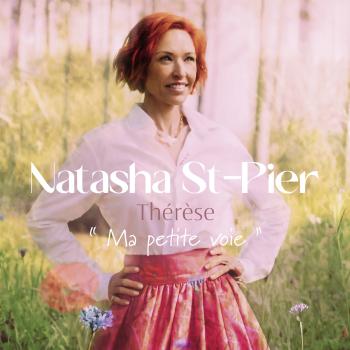
The following year, she took part in Grégoire’s project *Thérèse, Vivre d'Amour*, based on the poems of Saint Thérèse of Lisieux. In the autumn of 2015, the Quebecois singer paid tribute to the traditional songs of her homeland with the album *Mon Acadie*, featuring contributions from Roch Voisine, Michel Fugain, Tony Carreira, Grégoire, Edith Butler, Christian Kit Goguen, and Danny Boudreau. She then turned her attention to a children's album, *L'Alphabet des Animaux* (2017), before returning to the writings of the canonized Carmelite nun for *Thérèse de Lisieux - Aimer C'est Tout Donner* (2018), which included appearances by Mario Pelchat, Grégory Turpin, Battista Acquaviva, Lou (from *The Voice Kids*), and the group Glorious.