




Royal Liverpool Philharmonic Orchestra & Dane Lam
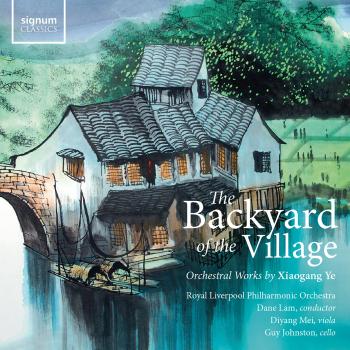
Biographie Royal Liverpool Philharmonic Orchestra & Dane Lam
Diyang Mei
Since his brilliant success at the 2018 ARD International Music Competition—where he won first prize in the viola category, the Audience Prize, and several special awards—violist Diyang Mei has steadily advanced his international career. Since 2022, he has served as the 1st Principal Viola of the Berlin Philharmonic.
Diyang Mei has performed with major orchestras including the Bavarian Radio Symphony Orchestra, BBC Symphony Orchestra, SWR Symphony Orchestra Stuttgart, Munich Chamber Orchestra, Deutsche Radio Philharmonie, and Konzerthausorchester Berlin. He organized and led a concert tour in China with the Berlin Baroque Soloists, performing as soloist and recording a concerto album on Sony Classical with them. Alongside his solo activities, he regularly participates in chamber music, frequently collaborating with renowned musicians and ensembles. He has also appeared at prestigious festivals such as Mecklenburg-Vorpommern, Schwetzingen, and the Mozartfest in Würzburg.
Before joining the Berlin Philharmonic, he was principal viola of the Munich Philharmonic from 2019 to 2022. He currently holds a visiting professorship at the Hochschule für Musik Hanns Eisler in Berlin.
Diyang Mei has won first prizes at the 52nd International Instrumental Competition for Viola in Markneukirchen (2017), the International Max Rostal Competition in Berlin (2015), the Kulturkreis Gasteig Musikpreis in Munich (2015), the IVC Young Artist Competition in Rochester (2012), among others. He studied with Shaowu Wang in Beijing, Hariolf Schlichtig in Munich, and Nobuko Imai at the Kronberg Academy. He is a fellowship winner of the Borletti-Buitoni Trust and plays on a viola made by Antonio Mariani around 1646, generously loaned to him by a member of the Stretton Society.
Guy Johnston
is one of the most exciting British cellists of his generation. His early successes included winning the BBC Young Musician of the Year, the Shell London Symphony Orchestra Gerald MacDonald Award and a Classical Brit. He has performed with many leading international orchestras including the London Philharmonic, Philharmonia Orchestra, Ulster Orchestra, BBC Philharmonic, NHK Symphony Orchestra, BBC Symphony, Britten Sinfonia, Deutsches Symphonie-Orchester Berlin, Orquestra Sinfônica do Estado de São Paulo, Moscow Philharmonic and St Petersburg Symphony.
Recent seasons have included concertos of Tchaikovsky, Martinů, Sibelius, Elgar and Haydn with the BBC Philharmonic and Ilan Volkov, the BBC Symphony Orchestra and Sakari Oramo, the Aurora Orchestra, Royal Northern Sinfonia and the Rheinische Philharmonie. Recent Proms performances include the premiere of Charlotte Bray’s Falling in the fire. Guy continues to play chamber music at Wigmore Hall and in festivals across Europe. He gave the premiere of the Howells cello concerto in Gloucester Cathedral and is delighted to have recorded this piece. Other recent recordings include a celebration of the tricentenary of his David Tecchler cello and Themes and variations with Tom Poster.
Guy is an inspiring leader of young musicians and is involved with several charities promoting music education for young people, including Music First, Future Talent and the Pierre Fournier Award for young cellists.
His mentors have included Steven Doane, Ralph Kirshbaum, Bernard Greenhouse, Steven Isserlis and Anner Bylsma.
He is a founder member of the award-winning Aronowitz Ensemble and founding Artistic Director of Hatfield House Chamber Music Festival, a guest Professor of Cello at the Royal Academy of Music, where he was awarded an Hon. ARAM in 2015, and holds a professorship at the Eastman School of Music in Rochester, New York.
Guy plays a 1714 David Tecchler cello, generously on loan from the Godlee-Tecchler Trust which is administered by The Royal Society of Musicians.
Xiaogang Ye
was born in Shànghǎi in September 1955. He studied with his linguist father, the gifted opera, film, theatre and symphonic composer Yè Chūnzhī (Ip Shun-Chi to British Hongkongers), going on to train in ballet from the age of six. His mother, Hé Shuǐyīng, instrumental in his early twenties for encouraging him to compose, was a singer. The turmoil of Máo Zédōng’s Cultural Revolution (1966-76), sociopolitically purging Western music and values from the landscape, scarred his teens: his father was sent to a labour farm, Ye himself to a factory. Deprived of a piano, waiting for the violence, persecution and chaos to stop, he recalls the decade and its ‘sent-down youth’ movement as a ‘boundless sea of bitterness’. Between 1978 and 1983, one of only twenty-six selected from 2,000 composition applicants, he studied with Dù Míngxīn (Moscow taught) at China’s re-opened Central Conservatory of Music in Běijīng, his peers including Tán Dùn and Zhōu Lóng, two years ahead of him, as well as Chén Yí, Chén Qígāng and Guō Wénjǐng. In 1980 he encountered the radical new-blood thinking and analytics of Alexander Goehr, the first Western composer to teach in Beijing following the Revolution. Subsequently (1987) he went to New York with a scholarship to the Eastman School of Music at the University of Rochester, studying with Samuel Adler and Joseph Schwantner, further independent input coming from the (very different) Dutchman Louis Andriessen. He returned to China in 1994, the following year, aged forty, joining the German publishers Schott Music, their first Chinese signing.
Ye has been described as ‘a quicksilver personality who laughs wryly, exudes determination and likes to dress in black’ (Didi Kirsten Tatlow, New York Times, 16 May 2012). Literary focused, he speaks and writes profusely. Conscious that there is always room to educate and enlighten, concerned that ‘today there are still people being crushed, who can’t publish their works, and not just one or two’, he’s been for some years a polarising force in China’s cultural and academic life, pursuing key educational and leadership roles with the China Federation of Literary and Art Circles and the China Musicians Association as well as Standing Committee membership of the 11th-13th Chinese People’s Political Consultative Conferences (2008-23). Founding Dean of the School of Music, The Chinese University of Hong Kong, Shēnzhèn (2021), he’s held a number of high-profile professorial positions and honorifics at home and abroad, including a Guggenheim Fellowship (2012), vice-chair of UNESCO’s International Music Council Executive Committee (2019-21), and election to the American Academy of Arts & Sciences (2020). In 2002 he established the Běijīng Modern Music Festival, supported by the Ministry of Education and the Ministry of Culture and Tourism hosted by the Central Conservatory. This was followed in 2017 with the diverse, crossover Shēnzhèn ‘Belt and Road’ International Music Festival connecting Asia with Europe in the ‘treasure ships and friendship’ (Xí Jìnpíng) spirit of the old ‘Silk’ trading routes—the October 2025 edition comprising 21 productions, 29 concerts and ‘high-end’ soloists and ensembles small and large from around 30 countries (upwards of a thousand performers in 2023) with over 60% of the repertory featuring premieres. Since 2013 his ‘China Story’ concert series has promoted contemporary Chinese music, the Chinese message, worldwide.
Dane Lam
an Australian-Chinese-Singaporean conductor, is known for performances that unite precision with passion and for a rare ability to lead across borders—musically, geographically, and institutionally. He works in opera and orchestral music with equal fluency and has built a career defined not only by international reach but by the artistic and civic renewal he brings to the organisations he serves.
The only conductor in the world to hold major positions in the United States, Australia, and Asia, Dane is Music and Artistic Director of the Hawai‘i Symphony Orchestra, Artistic Director of State Opera South Australia, and Principal Conductor of the Xi’an Symphony Orchestra. Few conductors lead major ensembles on three continents—and even fewer do so while commissioning new work, expanding audiences, and strengthening cultural identity in each place.
In Hawai‘i, since his appointment in 2023, Dane has led a resurgence of the Symphony’s role in civic life. He has introduced televised concerts, launched the HapaSymphony series blending classical and Hawaiian music, expanded audiences to record levels, and commissioned new works from across the Pacific alongside core repertoire in his Masterworks program. In 2024-25, he led the orchestra’s first complete Beethoven Symphony Cycle in its 125-year history—pairing Beethoven with Pacific Rim composers such as Xiaogang Ye and reviving the music of Honolulu-born Dai-Keong Lee (1915-2005), neglected for decades. His programming places Beethoven beside local legends and new voices beside overlooked ones, reframing tradition for a living community.
Whether conducting Mahler or Mozart, in Waikīkī, Xi’an, or Adelaide, Dane Lam doesn’t just build concerts—he builds bridges: between cultures and communities, between artists and audiences, and between what music has been and what it still can be today.