



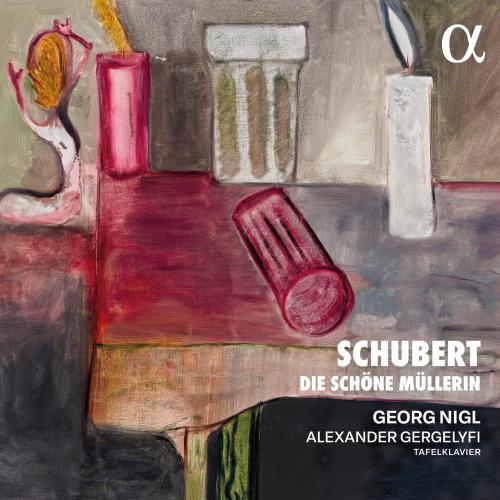
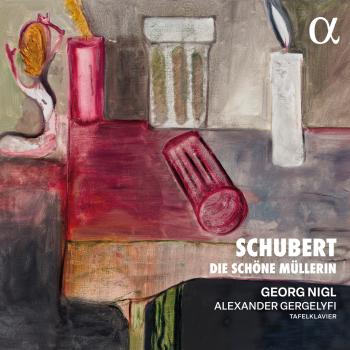
Schubert: Die schöne Müllerin Georg Nigl & Alexander Gergelyfi
Album info
Album-Release:
2026
HRA-Release:
14.08.2026
Label: Alpha Classics
Genre: Classical
Subgenre: Vocal
Artist: Georg Nigl & Alexander Gergelyfi
Composer: Franz Schubert (1797-1828)
Album including Album cover Booklet (PDF)
- Franz Schubert (1797 - 1828): Die Schöne Müllerin, D. 795:
- 1 Schubert: Die Schöne Müllerin, D. 795: Der Dichter, als Prolog 03:16
- 2 Schubert: Die Schöne Müllerin, D. 795: No. 1, Das Wandern 03:48
- 3 Schubert: Die Schöne Müllerin, D. 795: No. 2, Wohin? 02:31
- 4 Schubert: Die Schöne Müllerin, D. 795: No. 3, Halt! 01:39
- 5 Schubert: Die Schöne Müllerin, D. 795: No. 4, Danksagung an den Bach 03:42
- 6 Schubert: Die Schöne Müllerin, D. 795: No. 5, Am Feierabend 03:25
- 7 Schubert: Die Schöne Müllerin, D. 795: No. 6, Der Neugierige 05:37
- 8 Schubert: Die Schöne Müllerin, D. 795: Das Mühlenleben 02:12
- 9 Schubert: Die Schöne Müllerin, D. 795: No. 7, Ungeduld 03:28
- 10 Schubert: Die Schöne Müllerin, D. 795: No. 8, Morgengruss 05:37
- 11 Schubert: Die Schöne Müllerin, D. 795: No. 9, Des Müllers Blumen 04:01
- 12 Schubert: Die Schöne Müllerin, D. 795: No. 10, Tränenregen 04:59
- 13 Schubert: Die Schöne Müllerin, D. 795: No. 11, Mein! 02:43
- 14 Schubert: Die Schöne Müllerin, D. 795: No. 12, Pause 05:21
- 15 Schubert: Die Schöne Müllerin, D. 795: No. 13, Mit dem grünen Lautenbande 01:57
- 16 Schubert: Die Schöne Müllerin, D. 795: No. 14, Der Jäger 01:21
- 17 Schubert: Die Schöne Müllerin, D. 795: No. 15, Eifersucht und Stolz 02:02
- 18 Schubert: Die Schöne Müllerin, D. 795: Erster Schmerz, letzter Scherz 02:04
- 19 Schubert: Die Schöne Müllerin, D. 795: No. 16, Die liebe Farbe 06:40
- 20 Schubert: Die Schöne Müllerin, D. 795: No. 17, Die böse Farbe 02:19
- 21 Schubert: Die Schöne Müllerin, D. 795: Blümlein Vergißmein 02:03
- 22 Schubert: Die Schöne Müllerin, D. 795: No. 18, Trockne Blumen 05:37
- 23 Schubert: Die Schöne Müllerin, D. 795: No. 19, Der Müller und der Bach 05:21
- 24 Schubert: Die Schöne Müllerin, D. 795: No. 20, Des Baches Wiegenlied 08:02
- 25 Schubert: Die Schöne Müllerin, D. 795: Der Dichter, als Epilog 02:08
Info for Schubert: Die schöne Müllerin
Georg Nigl and Alexander Gergelyfi present Die schöne Müllerin in a version that is quite different from what we usually hear. Thanks to the use of a Tafelklavier (square piano) built around 1810 by Carl Withum, the baritone says he has had to “fundamentally rethink my previous experience of Lieder singing,” as the piano’s range of timbres opens up new perspectives. Since the publication of Schubert’s famous song cycle in 1824, the way the work is interpreted and received has changed drastically, due to the power of modern grand pianos and the exponential growth in the size of concert halls. Whereas in Schubert’s time, the intensity of expression and the power of the words themselves took precedence, “to such an extent that one might think the instrument—that is, the accompaniment—becomes the starting point of the musical message,” says Nigl, who decided to add and recite Wilhelm Müller’s texts that were not set to music, notably the prologue, the epilogue, and a few other poems. Following in the tradition of the “Liederspiel” (song play), which was very popular in 19th-century Berlin salons, Nigl and Gergelyfi offer a profoundly renewed listening experience.
Georg Nigl, baritone
Alexander Gergelyfi, square piano
Georg Nigl
is internationally acclaimed for the intensity, authenticity, and dramatic conviction of his performances. Whether as Wozzeck at La Scala, in the title role of Wolfgang Rihm's Jakob Lenz in Brussels and Berlin, or as Gabriel von Eisenstein in Strauss's Die Fledermaus at the Bavarian State Opera, he has consistently won praise from audiences and critics alike. His profound engagement with every work he performs, his close affinity with spoken theatre, and his exceptional sensitivity to language and rhetoric have established him as one of the most distinctive and celebrated baritones in the world.
Music has been central to Nigl's life from an early age. As a soprano soloist with the Vienna Boys' Choir, he appeared on many of the world's leading stages before continuing his studies with the legendary Kammersängerin Hilde Zadek, who provided important artistic guidance for his later career as a baritone.
His uniquely recognisable timbre and compelling stage presence have taken him to the world's foremost opera houses and festivals, including the Bolshoi Theatre in Moscow, Berlin State Opera, Bavarian State Opera, Théâtre des Champs-Élysées, Dutch National Opera, and La Monnaie in Brussels, as well as the Salzburg Festival, Festival d'Aix-en-Provence, Ruhrtriennale, and Wiener Festwochen. He has collaborated with many of the leading conductors of our time, among them Daniel Barenboim, Teodor Currentzis, Valery Gergiev, Daniel Harding, Pablo Heras-Casado, Nikolaus Harnoncourt, René Jacobs, Vladimir Jurowski, Ingo Metzmacher, Kent Nagano, Kirill Petrenko, and Sir Simon Rattle, as well as directors including Andrea Breth, Romeo Castellucci, Frank Castorf, Barrie Kosky, Hans Neuenfels, Johan Simons, Dmitri Tcherniakov, and Sasha Waltz.
Alongside his operatic career, Nigl has earned particular recognition as a leading interpreter of contemporary music. He has appeared in numerous world premieres and has served as an important artistic collaborator and source of inspiration for composers including Friedrich Cerha, Pascal Dusapin, Georg Friedrich Haas, Wolfgang Mitterer, Olga Neuwirth, and Wolfgang Rihm.
His extensive recital repertoire ranges from the Baroque and Viennese Classical periods to contemporary music, developed in close collaboration with artists such as Alexander Melnikov, Luca Pianca, Olga Pashchenko, and Alexander Gergelyfi. His recording Vanitas, featuring Beethoven's An die ferne Geliebte, songs by Schubert, and Wolfgang Rihm's Vermischter Traum, received the 2021 Annual Prize of the German Record Critics' Award. His 2023 album Echo, devoted to songs and ballads by Schubert, Loewe, Schumann, and Wolf, was widely acclaimed by the press. In 2025, Alpha Classics released Mozarts Clavichord, recorded with clavichordist Alexander Gergelyfi and featuring songs and arias by Mozart; in summer 2026, Alpha will release their recording of Schubert's Die Schöne Müllerin on period fortepiano.
Recent seasons have included the world premiere of Beat Furrer's Violetter Schnee at the Berlin State Opera and his widely acclaimed interpretation of Jakob Lenz, which he also performed in concert at the Salzburg Festival. At the Vienna State Opera, he has celebrated major successes as Eisenstein in Die Fledermaus, the title role in Monteverdi's Orfeo, Ulisse in Il ritorno d'Ulisse in patria, Nekrotzar in Ligeti's Le Grand Macabre, and Clov in Kurtág's Fin de partie. At the Bavarian State Opera, his roles have included the title role of Wozzeck, Mercurio in Cavalli's La Calisto, Gloucester in Reimann's Lear, and Gabriel von Eisenstein. Other notable appearances include Don Alfonso in Così fan tutte at the Festival d'Aix-en-Provence, Klingsor in Parsifal at the Tyrolean Festival Erl, and the world premiere of Olga Neuwirth's Monster's Paradise in Hamburg and Zurich. His first Alberich in Wagner's Ring des Nibelungen at the Vienna State Opera also attracted considerable attention.
Since 2023, Nigl has created one of the Salzburg Festival's most distinctive offerings with Nachtmusiken, a series of self-conceived serenade programmes developed together with clavichordist Alexander Gergelyfi and guest actors. Following its success in Salzburg, the project continues at Deutsche Oper Berlin in the 2026/27 season, with programmes featuring August Diehl, Nina Hoss, Alexander Gergelyfi, and Olga Pashchenko.
In summer 2026, Nigl returns to the Salzburg Festival in Pascal Dusapin's Passion and in the title role of Hans Werner Henze's Der Prinz von Homburg. During the 2026/27 season, he appears once again as Papageno in Mozart's Die Zauberflöte at the Vienna State Opera and makes his role debut as Dr Schön/Jack the Ripper in Berg's Lulu. He also continues his successful collaboration with the Vienna State Opera's NEST programme, where he conceives and presents a new edition of the Opera Quiz and joins Nicholas Ofczarek, August Diehl, and Alexander Gergelyfi for the production Pathos³. At the Bavarian State Opera, he appears as Alberich in Tobias Kratzer's new production of Wagner's Ring des Nibelungen, returns as Eisenstein in Die Fledermaus, and reprises the role of the Despot in Gordon Kampe's monodrama Die Kreide im Mund des Wolfs. He also returns to the Tyrolean Festival Erl as Klingsor in Parsifal.
Following the success of Die letzten Tage der Menschlichkeit? at the Vienna State Opera, Nigl and actor Nicholas Ofczarek bring the programme to the Klagenfurt Festival, Musikfest Bremen, Graz Opera, and the Brucknerhaus Linz.
Recent recital engagements have taken him to the Ludwigsburg Festival, Musikfest Bremen, Carinthischer Sommer, Cologne Philharmonie, the Berlin and Paris Philharmonies, and Hamburg's Elbphilharmonie, to which he returns in autumn 2026. In spring 2027, he joins Nicholas Ofczarek and Olga Pashchenko at the Vienna State Opera for a programme of fairy tales and ballads.
In Opernwelt magazine's annual critics' survey, Georg Nigl was named "Singer of the Year" in 2015 for his acclaimed interpretation of Wolfgang Rihm's Jakob Lenz.
Booklet for Schubert: Die schöne Müllerin