







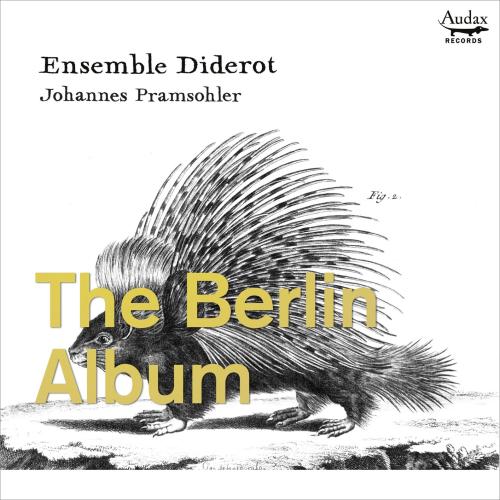
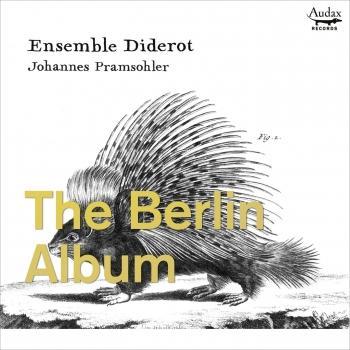
The Berlin Album Ensemble Diderot & Johannes Pramsohler
Album Info
Album Veröffentlichung:
2020
HRA-Veröffentlichung:
16.10.2020
Label: Audax Records
Genre: Classical
Subgenre: Chamber Music
Interpret: Ensemble Diderot & Johannes Pramsohler
Komponist: Franz Benda (1709-1786), Johann Gottlieb Graun (1703-1771), Johann Gottlieb Janitsch (1708-1763), Johann Philipp Kirnberger (1721-1783), Johann Abraham Peter Schulz (1747-1800)
Das Album enthält Albumcover Booklet (PDF)
- Georg Anton Benda (1722 - 0795): Trio sonata in E Major:
- 1 Trio sonata in E Major: I. Mezzo allegro 04:06
- 2 Trio sonata in E Major: II. Larghetto 02:25
- 3 Trio sonata in E Major: III. Presto 02:55
- Johann Gottlieb Graun (1703 - 1771): Trio sonata in A Major, GWV Av:XV:41:
- 4 Trio sonata in A Major, GWV Av:XV:41: I. Adagio 04:38
- 5 Trio sonata in A Major, GWV Av:XV:41: II. Allegro non troppo 04:31
- 6 Trio sonata in A Major, GWV Av:XV:41: III. Vivace. Allegro. Scherzando 07:02
- Johann Philipp Kirnberger (1721 - 1783): Trio sonata in D Minor:
- 7 Trio sonata in D Minor: I. Andante 02:12
- 8 Trio sonata in D Minor: II. Allegro 03:07
- 9 Trio sonata in D Minor: III. Presto 02:12
- Princess Anna Amalia of Prussia (1723 - 1787):
- 10 Fugue in D Major 02:17
- Johann Abraham Peter Schulz (1747 - 1800): Trio sonata in A Minor:
- 11 Trio sonata in A Minor: I. Allegretto 04:28
- 12 Trio sonata in A Minor: II. Adagio maestoso 02:29
- 13 Trio sonata in A Minor: III. Poco allegro 02:39
- Johann Gottlieb Graun: Trio sonata in G Major "Melancholicus & Sanguineus", GWV A:XV:11:
- 14 Trio sonata in G Major "Melancholicus & Sanguineus", GWV A:XV:11: I. Affettuoso 03:34
- 15 Trio sonata in G Major "Melancholicus & Sanguineus", GWV A:XV:11: II. Allegro non troppo 04:31
- 16 Trio sonata in G Major "Melancholicus & Sanguineus", GWV A:XV:11: III. Allegro di molto 04:24
- Johann Gottlieb Janitsch (1708 - 1763): Trio sonata in G Major:
- 17 Trio sonata in G Major: I. Andante 03:14
- 18 Trio sonata in G Major: II. Allegro ma non tanto 04:54
- 19 Trio sonata in G Major: III. Vivace alla lira 03:30
Info zu The Berlin Album
Following on from their critically acclaimed series, Ensemble Diderot continues its 'city series' - after Dresden, Paris and London now Berlin. All the works (except one) in this new recording are world premiere recordings - really exciting music. Uniquely, and some might say something rather radical for a "Berlin Album" no CPE Bach, no Quantz and no Flute! Instead on this rare selection of Trio Sonatas from Berlin, the Ensemble Diderot uses a wonderful copy of a Silbermann Fortepiano - the same as Frederick II had at the court - which gives an incredible variety of colours. When one contemplates mid eighteenth-century music from Berlin, the first thing that comes to mind is undoubtedly the flute-playing King Frederick II ("the Great"), and one asks oneself if a "Berlin" album should actually be a "Potsdam" album. The idea behind the present recording is to focus on Berlin, but without taking into account the three usually perceived musical protagonists: Frederick, his flute, and Carl Philipp Emanuel Bach. However, it is indeed primarily thanks to the cultural policy of the Prussian monarch that Berlin became a noteworthy musical centre. In contrast to Dresden, in Berlin music was not only made at court, but throughout the city and beyond. There were countless private venues in the capital city in which concerts were given with the participation of members of the royal chapel. Double bass player Janitsch continued the weekly concert series that he had already organised in Rheinsberg as "Friday Academies." Chamber music in Berlin was firmly in the hands of professional musicians - the compositions they played were not mass-produced pieces, but rather substantial works that were likewise demanding in terms of technique both violins play here on an entirely equal footing passages in seventh position that are more reminiscent of solo passages in a virtuoso violin concerto than chamber music for domestic use. All in all, Berlin, in contrast to Dresden, was a true chamber music El Dorado. Previous recordings have gained universal praise from the critics: "A dream team for this repertoire." Early Music Review "The Ensemble Diderot plays these works with nimble expertise and good spirit" GRAMOPHONE
Ensemble Diderot
Johannes Pramsohler, violin, direction
Ensemble Diderot
Founded in 2008 by violinist Johannes Pramsohler and a group of like-minded musicians, Ensemble Diderot has become an absolute reference in classical music. Their distinctive sound, the fresh approach to baroque music on original instruments inviting audiences to go on thought-provoking journeys, the creative use of historically informed performance, thorough research, and highly inventive programming have earned them a large international fan base, not only in the Early Music scene. The award-winning discography consisting mainly of world premiere recordings bears testimony to the adventurous spirit of the ensemble's members.
Johannes Pramsohler
With a PhD in Historically Informed Performance from the Royal Academy of Music and an extensive discography acclaimed by international critics, Johannes Pramsohler is widely acclaimed as one of the leading forces in the Early Music scene. A stimulating and inspirational personality with a desire for inventive programming and innovative collaborations, he brings a joyful sense of adventure to his music-making. Born in South Tyrol and now living in Paris, Johannes Pramsohler alternates his roles as artistic director and leader of Ensemble Diderot with that as a guest both as soloist and as conductor at the head of numerous groups. As artistic director and first violin of Ensemble Diderot, which he founded in 2008, he brings to life unknown repertoire with a keen sense for significant rarities and creative use of historically informed performance. As concertmaster, Johannes has collaborated with Concerto Köln, The King’s Consort, Le Concert d’Astrée, the European Union Baroque Orchestra, and as a guest of the Berlin Philharmonic with its early music ensemble Concerto Melante.
Johannes Pramsohler’s communicative skills and vast musicological knowledge make him a welcome guest as a soloist and increasingly also as a conductor of baroque orchestras and modern symphony orchestras alike. Thus he has performed with the Budapest Festival Orchestra and Ivan Fischer, the Taiwan Baroque Orchestra, Helsinki Baroque Orchestra, Darmstädter Barocksolisten, the Lower Saxony State Orchestra in Hanover, and the Tyrolean Symphony Orchestra Innsbruck, performing in concert halls such as the Berlin Philharmonie, Cologne Philharmonie, Queen Elizabeth Hall in London, Palau de la Música in Barcelona, and Suntory Hall in Tokyo.
Recent conducting engagements have taken him to the Teatro Colón in Buenos Aires for a staged production of Handel’s oratorio Theodora, to the Théâtre de l’Athénée and the Théâtre des Champs Elysées in Paris for the operas Dido & Aeneas by Purcell and Croesus by Reinhard Keiser, and to the Haus der Musik in Innsbruck where he conducted Beethoven symphonies.
A desire for artistic independence even in the recording studio led Johannes to found his own record label in 2013. Audax Records continues to release an astonishing variety of recordings, many of which have been awarded prizes including the Diapason d’Or, the German Record Critics’ Award (Preis der deutschen Schallplattenkritik), and the International Classical Music Award.
As a sought-after pedagogue, Johannes was responsible from 2011 until 2018 for the strings of the French Youth Baroque Orchestra, teaches at the Summer Academy of the Festival du Périgord Noir, and is regularly invited to give master classes at the Chinese Culture University in Taipei, the Shanghai Conservatory, the Norwegian Academy of Music, and the Instituto Superior de Arte del Teatro Colón in Buenos Aires.
Johannes Pramsohler studied at the Conservatory “C. Monteverdi” in Bozen with Georg Egger, at the Guildhall School of Music and Drama in London with Jack Glickman, David Takeno and Rachel Podger, at the Paris Conservatoire CRR with Patrick Bismuth, and at the Mozarteum Salzburg with Reinhard Goebel, and trained as an orchestra conductor with Nicolas Brochot in Evry. He obtained his doctoral degree (PhD) from the Royal Academy of Music with a thesis about style and performance issues of the early trio sonata in England and France. Johannes Pramsohler was a prizewinner at the 2011 Magdeburg International Telemann Competition. In 2010 he was awarded the Futura Award for young South Tyroleans abroad and in 2019 the Vincent Meyer award of the Royal Academy of Music. Since 2008 he has had the honour of owning Reinhard Goebel’s violin, a P. G. Rogeri made in 1713.
Booklet für The Berlin Album